What Is the Hardest Job in Film? A Breakdown of the Toughest Roles on Set
- There's no single "hardest job in film": difficulty splits into physical risk, technical precision, and psychological pressure, and different roles top each category.
- Stunt performers face what one veteran describes as a near-universal injury rate, backed by peer-reviewed research into underreported head trauma.
- Production sound mixers and script supervisors carry the highest technical precision demands, since sound and continuity are two of the hardest things to fix once the crew has moved on.
- Long hours make every job harder. In the UK, 35% of film and TV workers now rate their mental health as poor or very poor.
- Whatever role you're hiring, experience is what actually keeps a hard job from turning into a shoot-day disaster.
Ask anyone on a film set what the hardest job in film is, and you'll get a different answer depending on who you ask.
A camera operator will say focus pulling. A grip will say gaffing. A sound mixer will probably say booming, half-joking, half not.
They're all a little bit right. Difficulty on a film set isn't one thing.
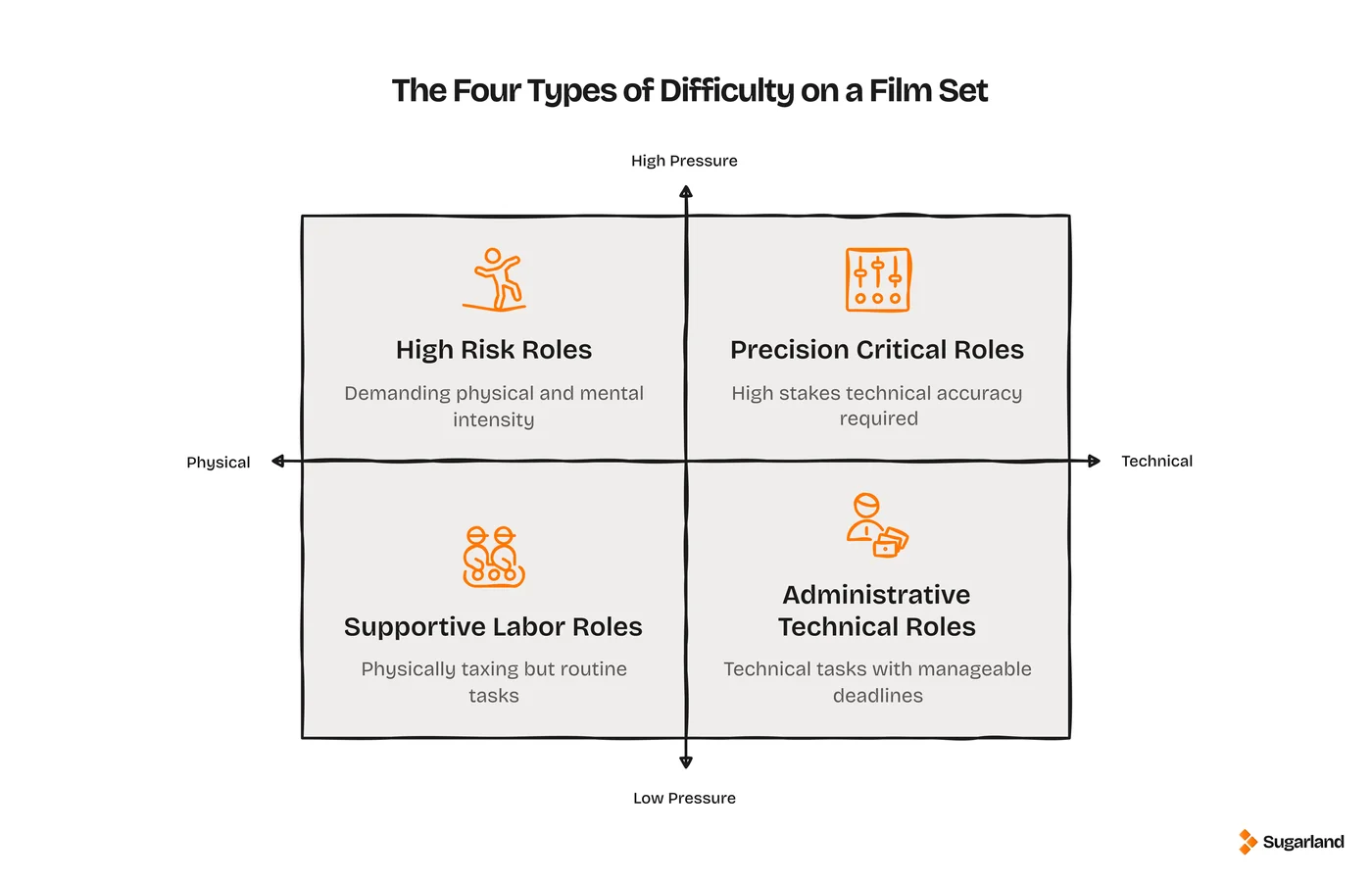
It comes down to two questions: how physical or technical the role is, and how much pressure it carries.
Here's a breakdown of where each type of "hardest" actually shows up, and why it matters when you're building a crew for your next shoot.
What Is the Hardest Job in Film, Really?
There's no single hardest job in film. It depends on two things: whether a role is physical or technical, and how much pressure comes with it.
Some roles are physical and high-pressure, like stunt work, where the strain is on the body and a mistake can't be undone.
Some are technical and high-pressure, like sound mixing and script supervision, where precision matters and there's rarely a fix once the crew has moved on.
Others sit in between: physical work that comes with real safety responsibility, or coordination roles where the pressure comes from managing people rather than gear.
The rest of this post walks through where each type shows up on a real shoot.
The 1st Assistant Director: Keeping a Chaotic Set on Schedule
The 1st assistant director doesn't direct anything creatively.
Instead, they run the physical machinery of the shoot: building the schedule, managing the call sheet, and coordinating every department so filming stays on time.
It's a job that depends entirely on staying level-headed when several things are going wrong at once, which is why the best 1st ADs are described as needing a calm disposition under pressure more than any single technical skill.
Shoot days commonly run 12 to 16 hours, and the 1st AD is usually absorbing pressure from every direction at once: the director wants another take, the producer is watching the clock, and the light is about to go.
Get it right and nobody notices. Get it wrong and the whole day falls apart.
Grip and Gaffer: The Physical Toll Nobody Talks About
Grip and gaffer work is some of the most physically demanding on any set.
Days routinely run 12 to 14 hours, and much of that time is spent lifting, rigging and repositioning heavy equipment between setups, often at height and against the clock.
It's also a job with real safety authority attached.
Key grips are expected to know rigging standards well enough to override time pressure from the 1st AD or production office and call a stop when something isn't safe.
That combination, heavy labour plus safety responsibility, is why grip and electric crews tend to wear down faster than almost any other department on a long shoot.
If you're planning a multi-camera setup, it's worth remembering that every extra camera means another lighting rig, another set of stands, and another chunk of workload stacked on your grip crew.
Requesting the right equipment hire list early makes a genuine difference to how manageable that day actually is.
Stunt Performers: The Only Job With a Near-100% Injury Rate
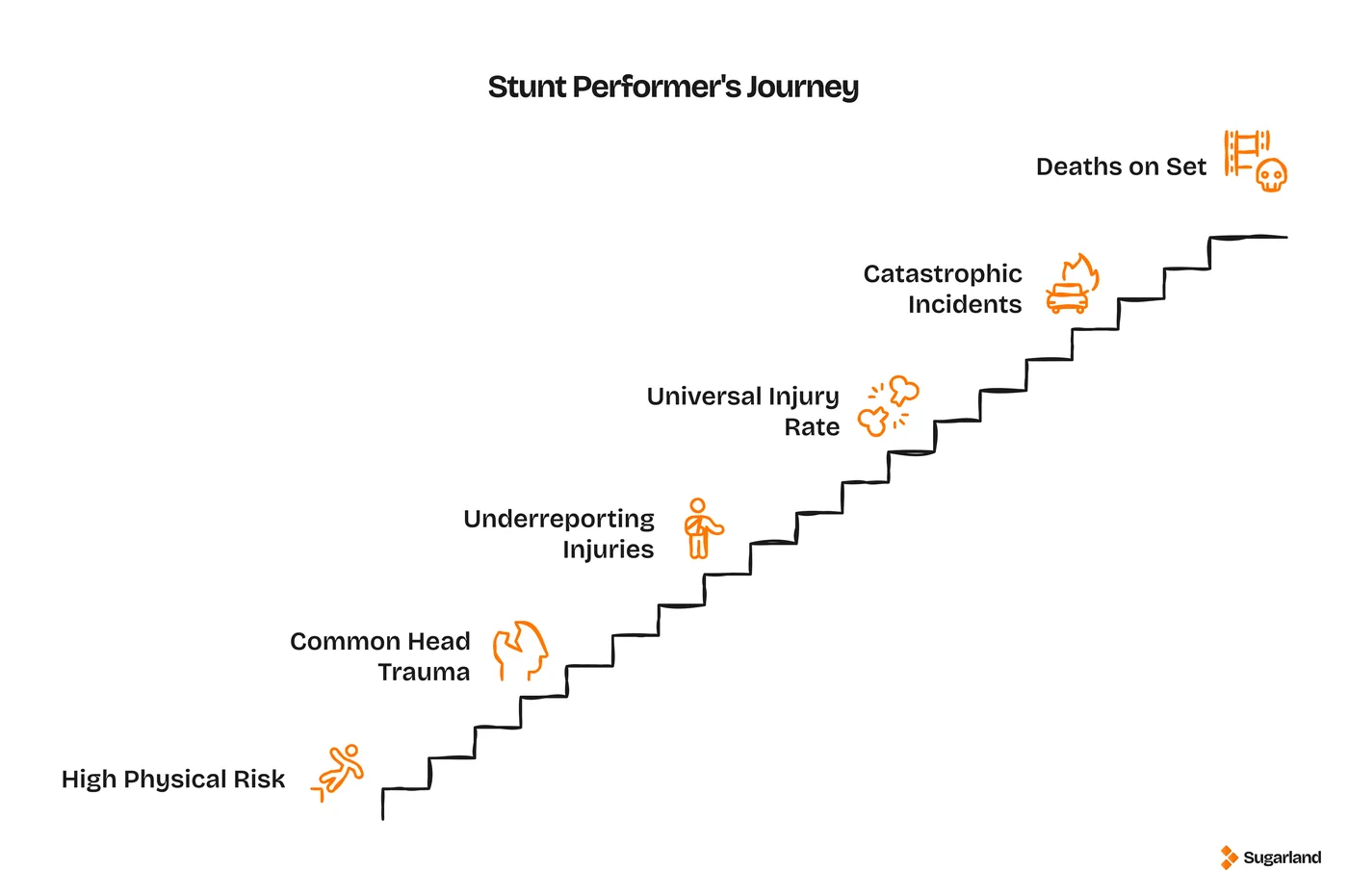
Stunt work carries the highest physical risk of any role in film, to the point where injury is treated as a near-inevitable part of the job rather than an exception.
A qualitative study into stunt performers found that head trauma and concussions are common in the profession, but performers regularly avoid reporting them due to stigma and a lack of the kind of medical oversight standard in professional sports.
One veteran stunt coordinator has gone as far as describing stunt work as the only job with an effectively universal injury rate across a career.
The wider data backs this up. An analysis of US film set incidents between 2002 and 2024 found 152 catastrophic incidents, including 32 deaths, with falls, vehicle accidents and stunt-related incidents among the leading causes.
Production Sound Mixer: No Fixing It in Post
Unlike almost every other creative department, a production sound mixer doesn't get much of a safety net.
If dialogue is unusable, the options are an expensive ADR session or a costly reshoot, neither of which anyone on the budget wants to hear about.
That means the mixer has to get clean audio right, on the day, in whatever acoustic environment they're handed: a busy street, an echoey warehouse, a windy exterior.
It's a role that works in real time under constant pressure to call out a bad take, sometimes against the wishes of a director who just watched a great performance and doesn't want to hear the audio was unusable.
Script Supervisor: Invisible Until Something Goes Wrong
Films are almost never shot in order, which means a script supervisor has to track continuity (props, wardrobe, dialogue, actor positions) across a schedule that might see the same scene picked up weeks or months apart.
Miss one detail and it's often too late to fix by the time anyone notices, since the crew and location are long gone by post-production.
It's described as one of the indispensable roles on any set precisely because nobody notices when it's done well.
The job only becomes visible when it's done badly, and by then the mistake is already in the footage.
Why Long Hours Make Every Job on Set Harder
Whatever role you're in, one factor makes every job on a film set harder: hours.
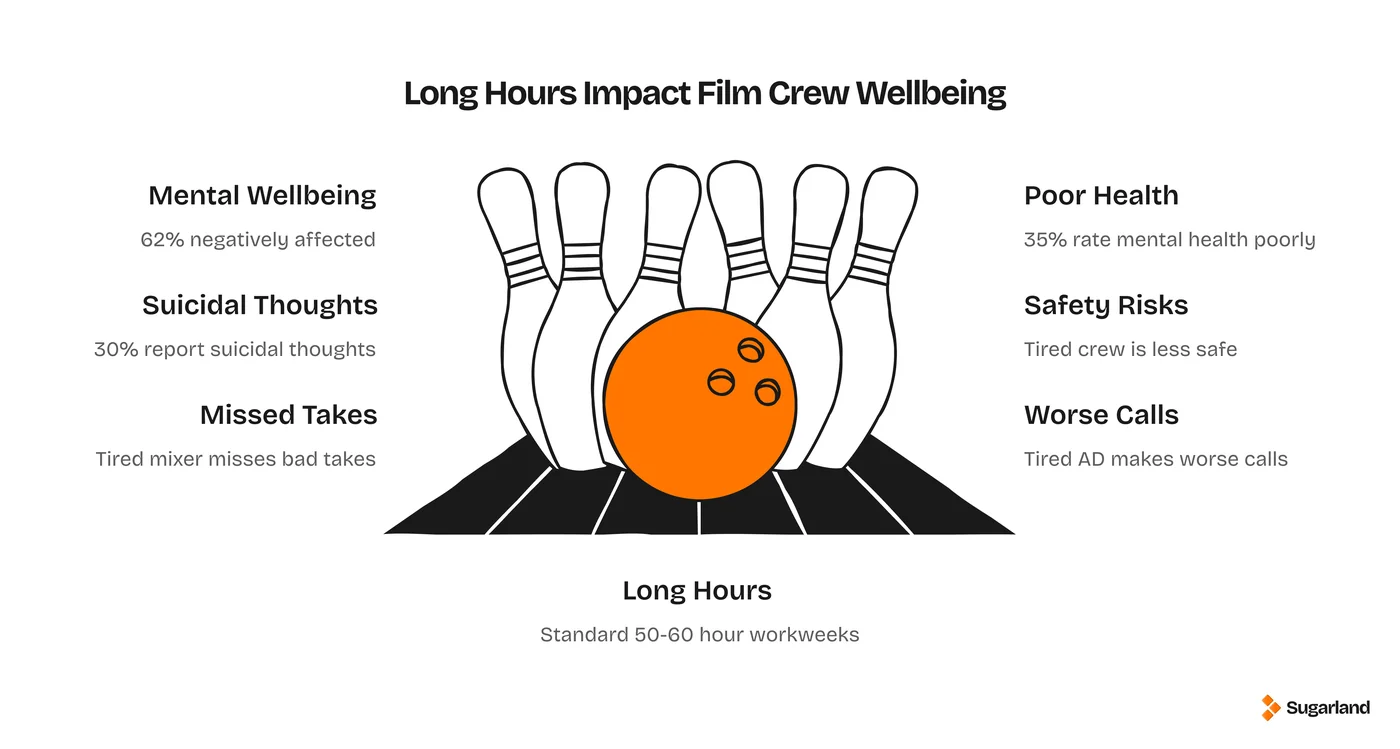
A global survey of over 150,000 film and TV crew across 22 countries found that 50 to 60-hour workweeks are now standard, with 62% of respondents saying the intensity of their schedule had negatively affected their mental wellbeing.
The picture in the UK is similarly stark.
The Film and TV Charity's most recent Looking Glass survey found that 35% of respondents rated their mental health as poor or very poor, up from 24% two years earlier, with 30% reporting suicidal thoughts in the past year.
That's a marked worsening from the industry's original 2019 findings, when 87% of respondents said they'd experienced a mental health problem at some point.
None of this is unique to one department.
Long hours compound every other pressure on this list: a tired grip is a less safe grip, a tired sound mixer misses more bad takes, and a tired 1st AD makes worse calls under pressure.
So, What Is the Hardest Job in Film?
There's no single hardest job in film.
What the roles above share is that they all depend on having someone properly experienced in the seat, because inexperience in any one of them tends to show up fast, and expensively, on a shoot day.
That's part of why productions come to Sugarland for crew hire rather than staffing these roles cold.
We work with directors, camera operators, sound recordists, gaffers and grips who've done the job enough times to handle the pressure that comes with it, whether that's a sound mixer who knows how to fight for a retake or a 1st AD who can keep a set on schedule without losing the room.
Request a quote and we'll put the right people on it.
We've put that experience to work across productions ranging from London Fashion Week runway shows to broadcast and music video shoots, and the common thread is always the same: the hardest job on set is whichever one nobody experienced was hired to do.
Let’s plan your next shoot
Get your equipment, studio and crew all in one place.