What Aperture Gives the Sharpest Image? How to Find Your Lens’s Sweet Spot
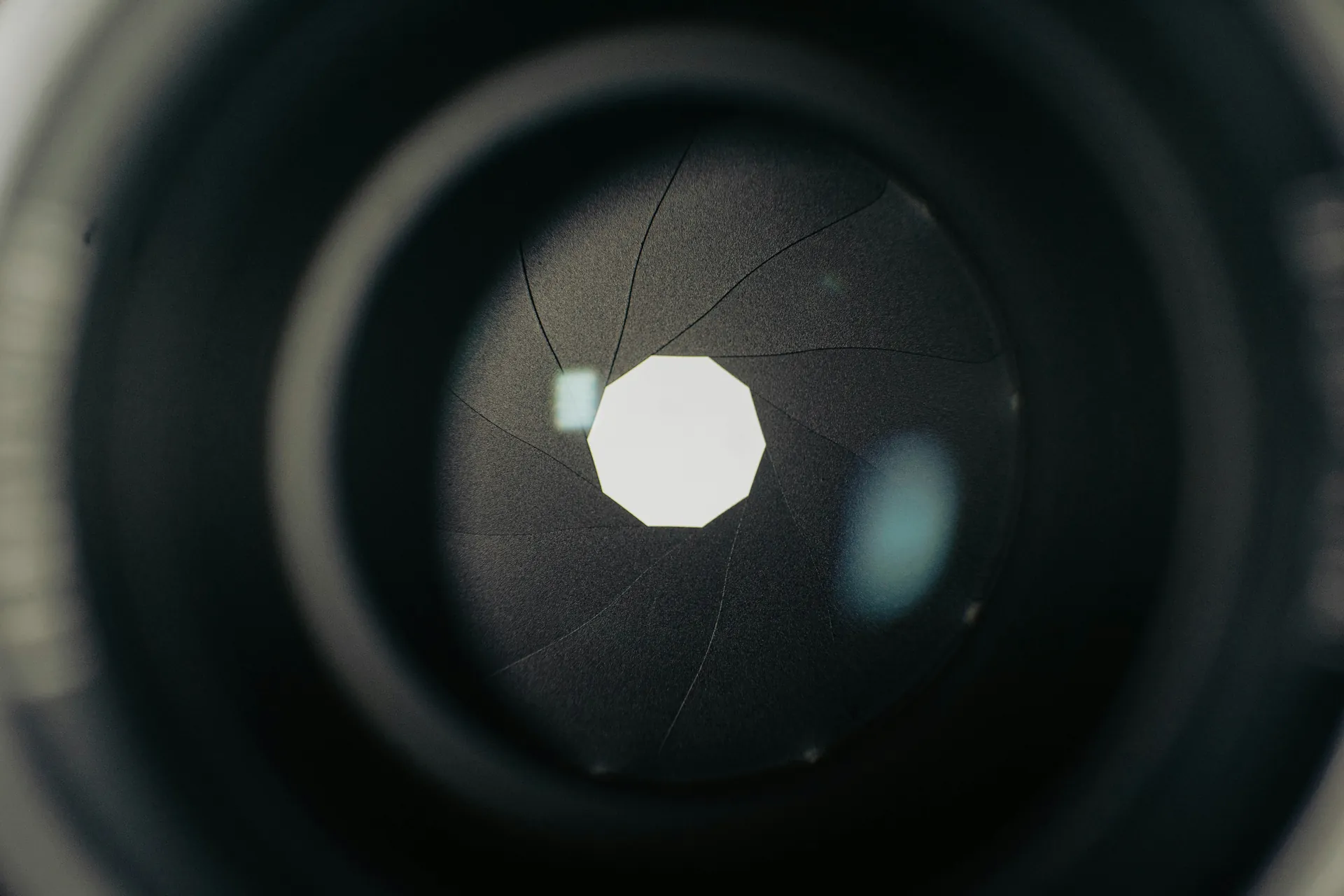
- The sharpest aperture on almost any lens sits 2 to 3 stops down from wide open, commonly f/5.6-f/8 (or T4-T5.6 on cine glass).
- Wide open apertures soften images because of optical aberrations at the edges of the lens.
- Very small apertures soften images too, because of diffraction, usually kicking in around f/11-f/16.
- Cinema lenses use T-stops instead of f-stops so exposure stays consistent across a whole lens set.
- Larger sensors push both the sweet spot and the diffraction limit further down the aperture scale than smaller ones.
If you've ever shot a test chart at every aperture your lens offers, you've probably noticed something odd: wide open isn't your sharpest shot, and neither is the smallest aperture on the barrel.
The sharpest result usually lands somewhere in the middle.
There's a reason for that, and once you understand it, choosing an aperture becomes a lot less guesswork and a lot more intentional, whether you're shooting stills or setting T-stops on a cine prime.
At a glance:
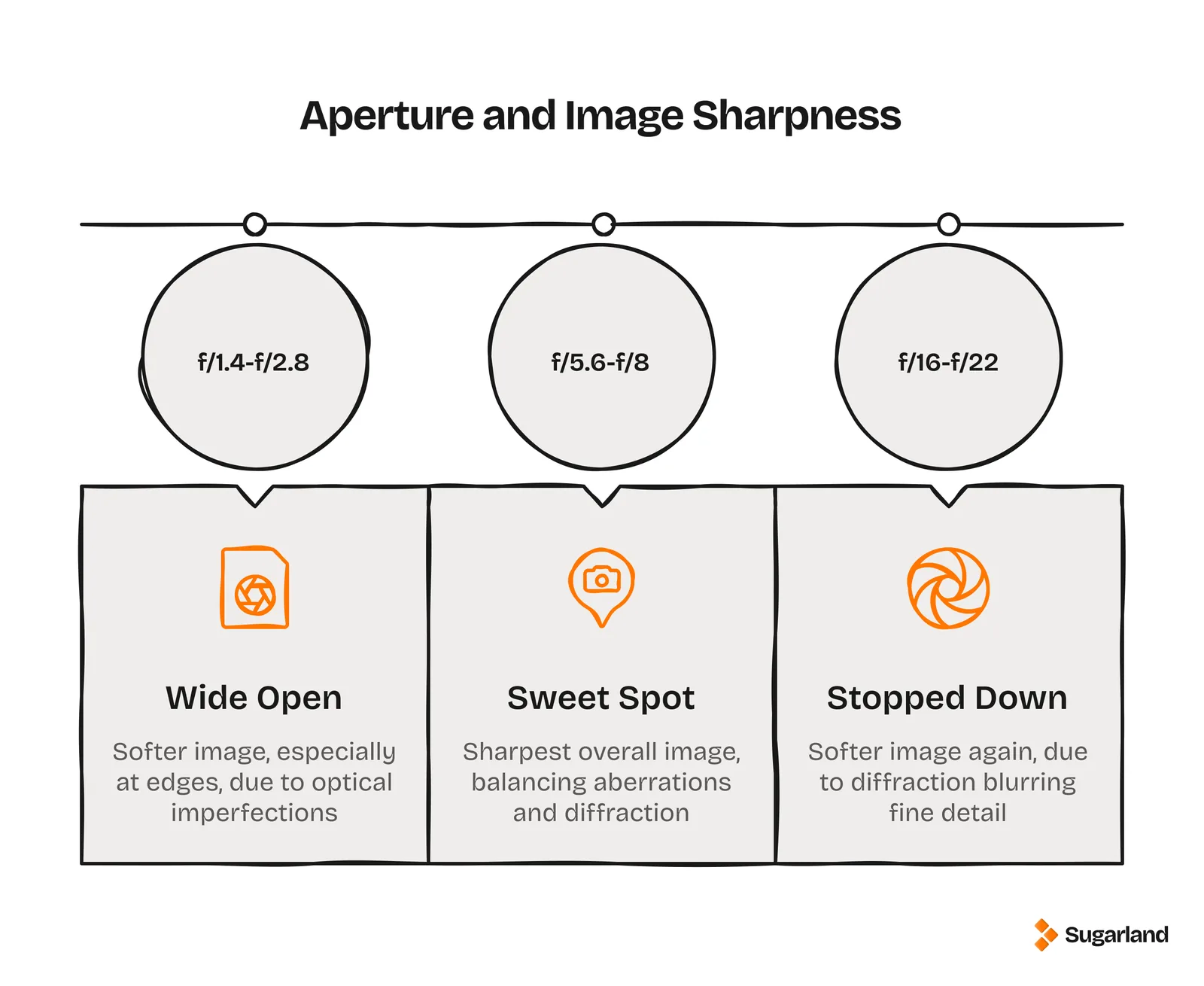
- Wide open (e.g. f/1.4-f/2.8): softer, especially toward the edges. Light passes through the outer edges of the glass, where optical imperfections are most pronounced.
- Sweet spot (e.g. f/5.6-f/8): sharpest overall. Aberrations have eased off, and diffraction hasn't kicked in yet.
- Stopped down (e.g. f/16-f/22): softer again. Diffraction bends light through the small opening, blurring fine detail.
What Aperture Gives the Sharpest Image?
Most lenses are sharpest 2 to 3 stops down from their widest setting, often somewhere around f/5.6 to f/8.
This is known as the lens's "sweet spot," and it's the result of two competing optical effects pulling in opposite directions: aberrations that soften the image wide open, and diffraction that softens it again once you stop down too far.
It's not a fixed number across every lens. Zooms tend to shift their sweet spot depending on focal length, and prime lenses often perform closer to wide open than zooms do.
If you want to know your specific lens's true sweet spot, the only reliable way is to test it: shoot a flat, detailed subject on a tripod at every aperture and compare.
Why Wide Open Apertures Aren't the Sharpest
Shooting wide open increases optical aberrations, which is why images often look softer at a lens's maximum aperture than a few stops down.
At the widest opening, light passes through the very edges of the glass elements, where imperfections in the lens design are most pronounced.
As the aperture narrows, those edge imperfections matter less, and sharpness improves.
This is why even expensive, professionally built lenses rarely publish their sharpest MTF results at maximum aperture.
It's simply how optics work, not a flaw specific to any one piece of glass.
Why Very Small Apertures Aren't the Sharpest Either
Stopping down too far softens the image through diffraction, which usually becomes visible somewhere around f/11 to f/16 depending on the lens and sensor.
Diffraction happens when light bends slightly as it squeezes through a very narrow aperture opening, and that bending blurs fine detail even though everything is technically in focus.
Lenses are typically sharpest a few stops before the smallest aperture available, not at it, so pushing past that for extra depth of field starts trading sharpness for coverage.
That trade-off isn't always a bad thing. If a shot genuinely needs everything in focus from foreground to background, a touch of diffraction softness is usually the better compromise over a razor-sharp plane surrounded by blur.
It's a call to make deliberately though, not by accident.
T-Stops vs F-Stops on Cinema Lenses
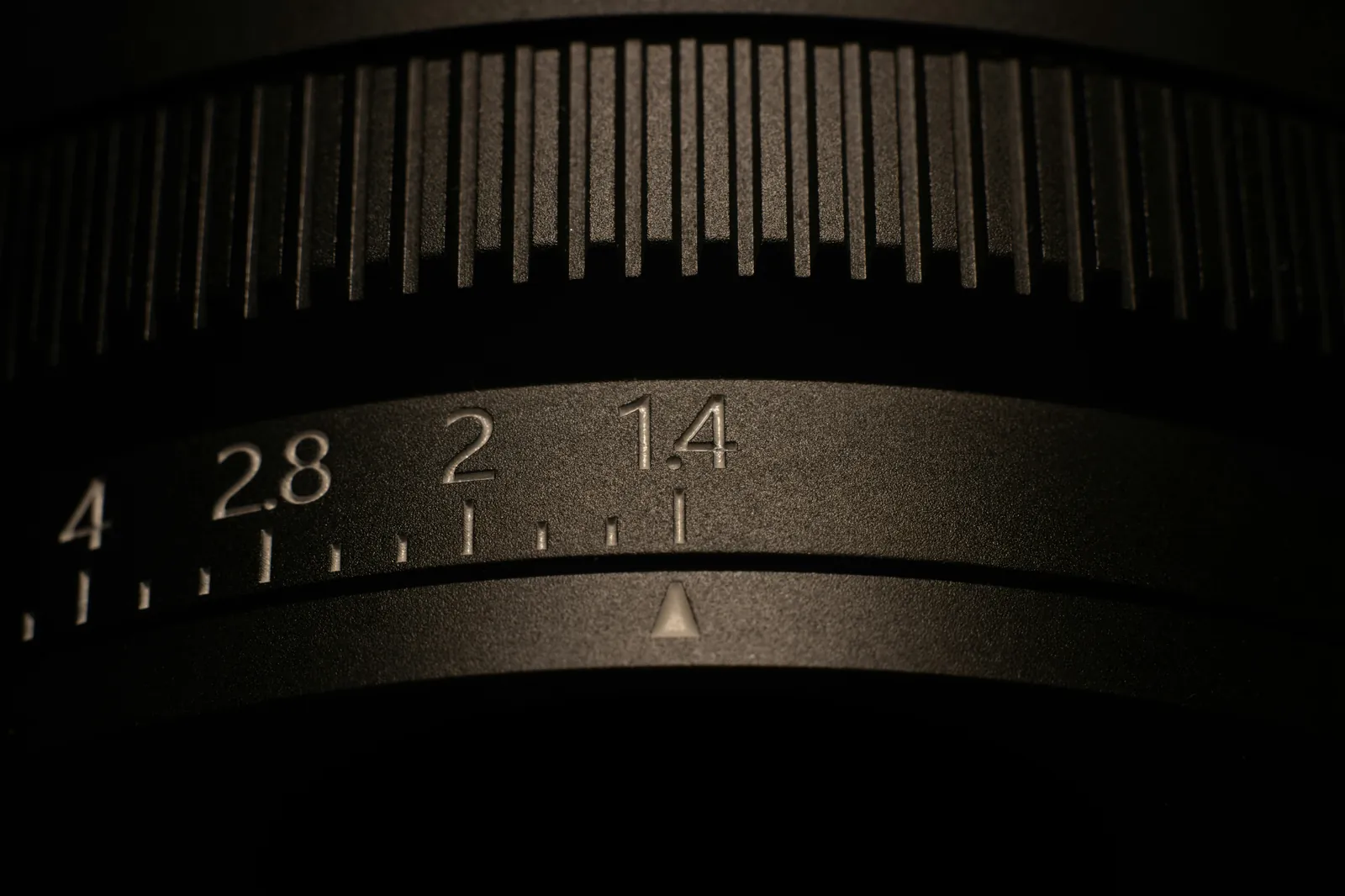
If you're working with PL-mount cine primes rather than stills lenses, you'll notice the aperture ring is marked in T-stops, not F-stops.
An F-stop is a purely mathematical measurement of aperture diameter relative to focal length, while a T-stop accounts for actual light transmission through the glass once you factor in the specific elements and coatings in that lens.
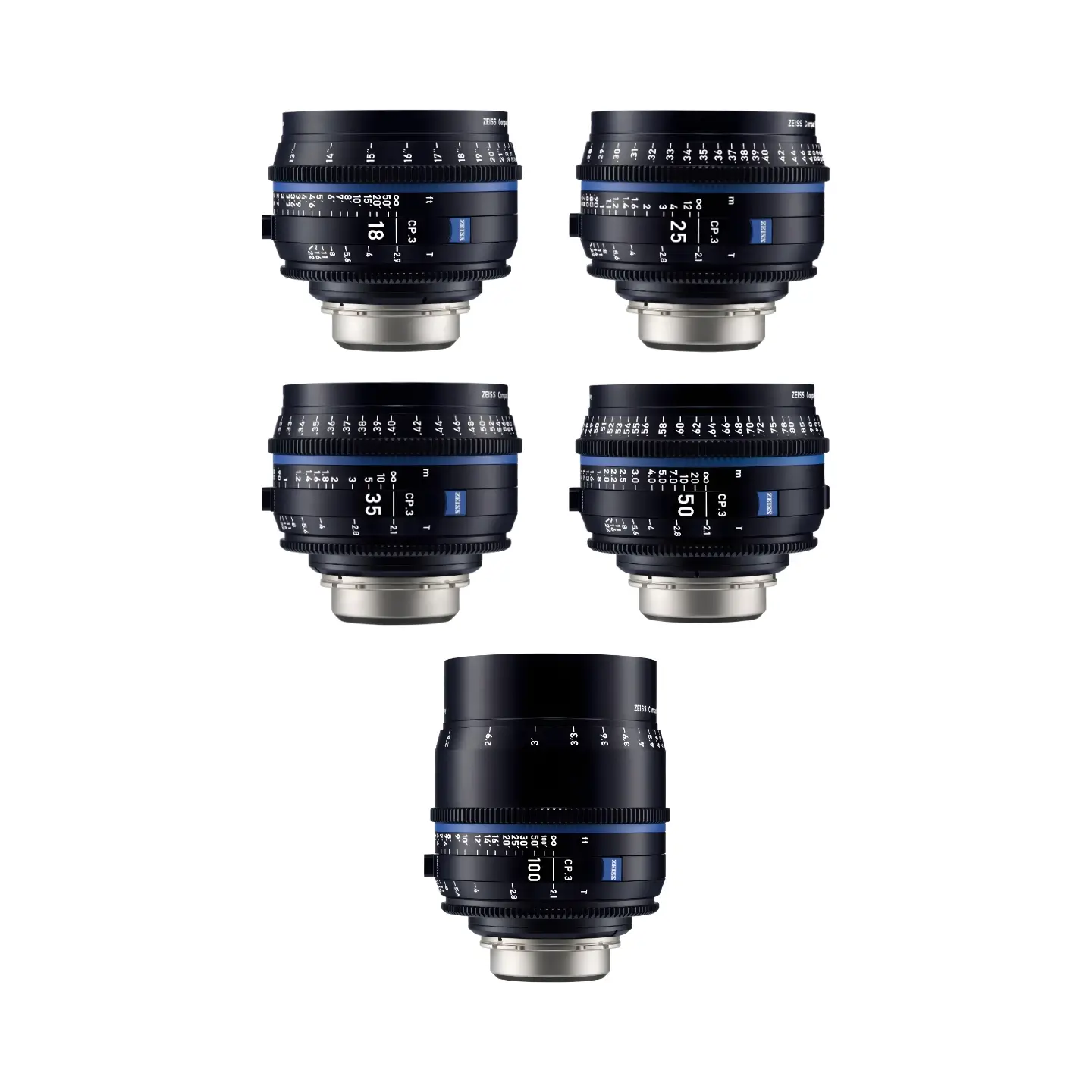
That distinction matters on set. Two lenses both marked f/2.8 might transmit slightly different amounts of light depending on their internal construction, which throws off exposure when you're cutting between cameras or swapping lenses mid-shoot.
T-stops remove that guesswork, which is why T2.8 became an industry standard for cinematographers: it balances a shallow enough depth of field to hold attention on the subject with just enough of the background still readable, without needing the shallowest possible stop.
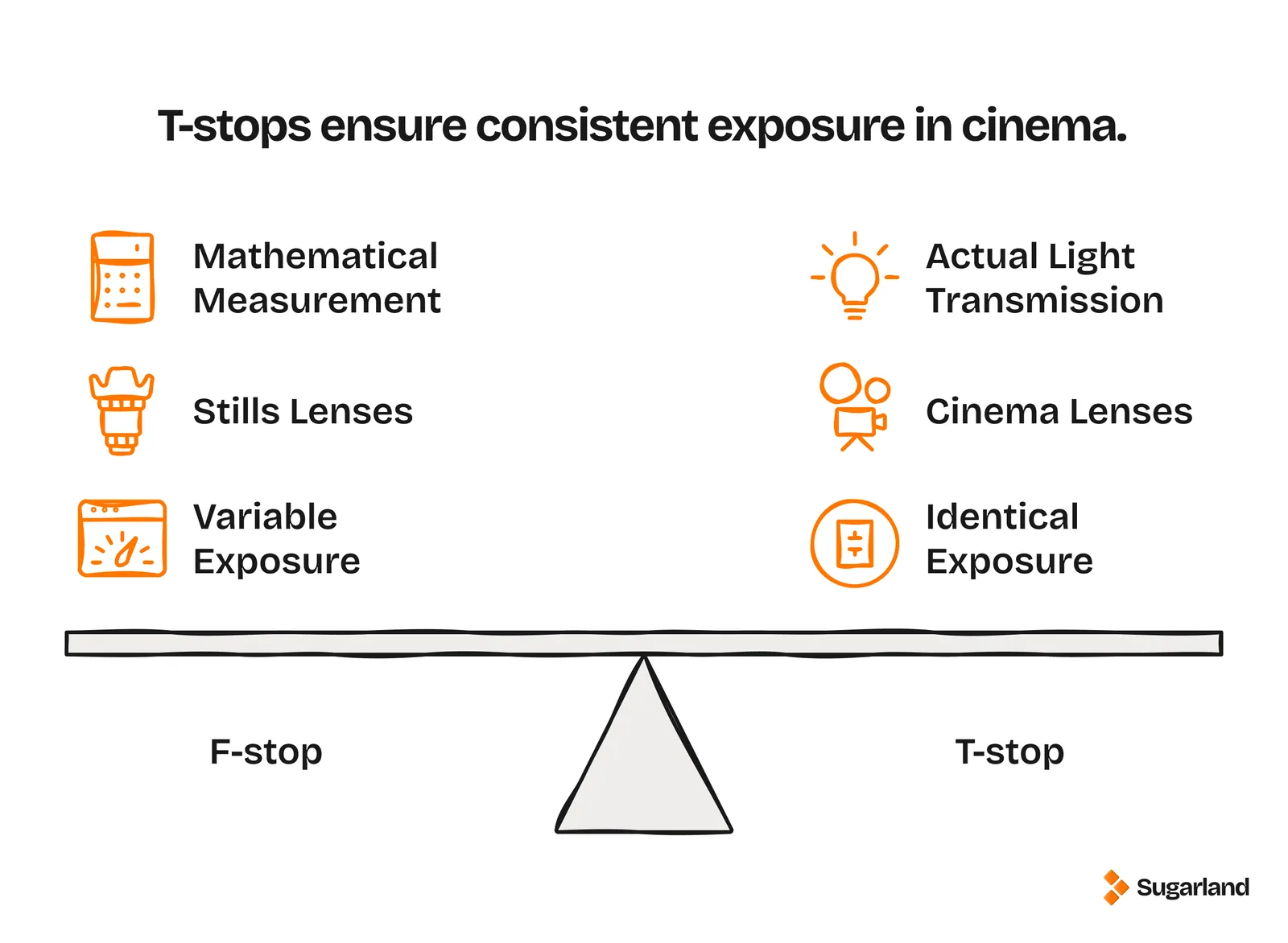
F-stop vs T-stop, in short:
- What it measures: an f-stop is aperture diameter relative to focal length, a maths calculation. A T-stop is the actual light transmitted through the glass, coatings and elements included.
- Where you'll see it: f-stops on stills lenses, T-stops on cinema lenses.
- Why it matters on set: two lenses at the same f-stop can expose differently. Two lenses at the same T-stop expose identically.
If you're pairing lenses for a shoot, our PL-mount cine primes are matched sets specifically so T-stops stay consistent across the whole range.
What Does an MTF Chart Actually Tell You?
An MTF chart shows how much contrast and detail a lens preserves across the frame, from center to edge, usually plotted at a couple of different apertures.
Most manufacturers publish MTF charts for their own lenses, including Nikon's own guide, so you can compare how a lens performs stopped down versus wide open before you ever put it on a camera.
Reading one isn't complicated once you know what you're looking at.
The vertical axis runs from 0 to 1 as a percentage score, and reading the chart is mostly about noting how high and flat the lines stay across the frame.
Lines that stay high and flat from left to right indicate a lens that holds sharpness and contrast well from the center out to the edges, rather than one that's only sharp in the middle.
MTF charts won't tell you everything (they're measured under lab conditions, not on a real set), but they're a genuinely useful way to compare two lenses before booking one.
Does Sensor Size Change the Sweet Spot?
Yes, larger sensors shift both the sweet spot and the diffraction limit further down the aperture scale than smaller ones.
On a full-frame or Super 35mm sensor, lenses are typically aberration-limited from around f/5.6 and diffraction-limited from around f/11, a pattern documented across formats, giving a reasonably wide sweet spot to work within.
Smaller sensors compress that range considerably, meaning diffraction kicks in at noticeably wider apertures.
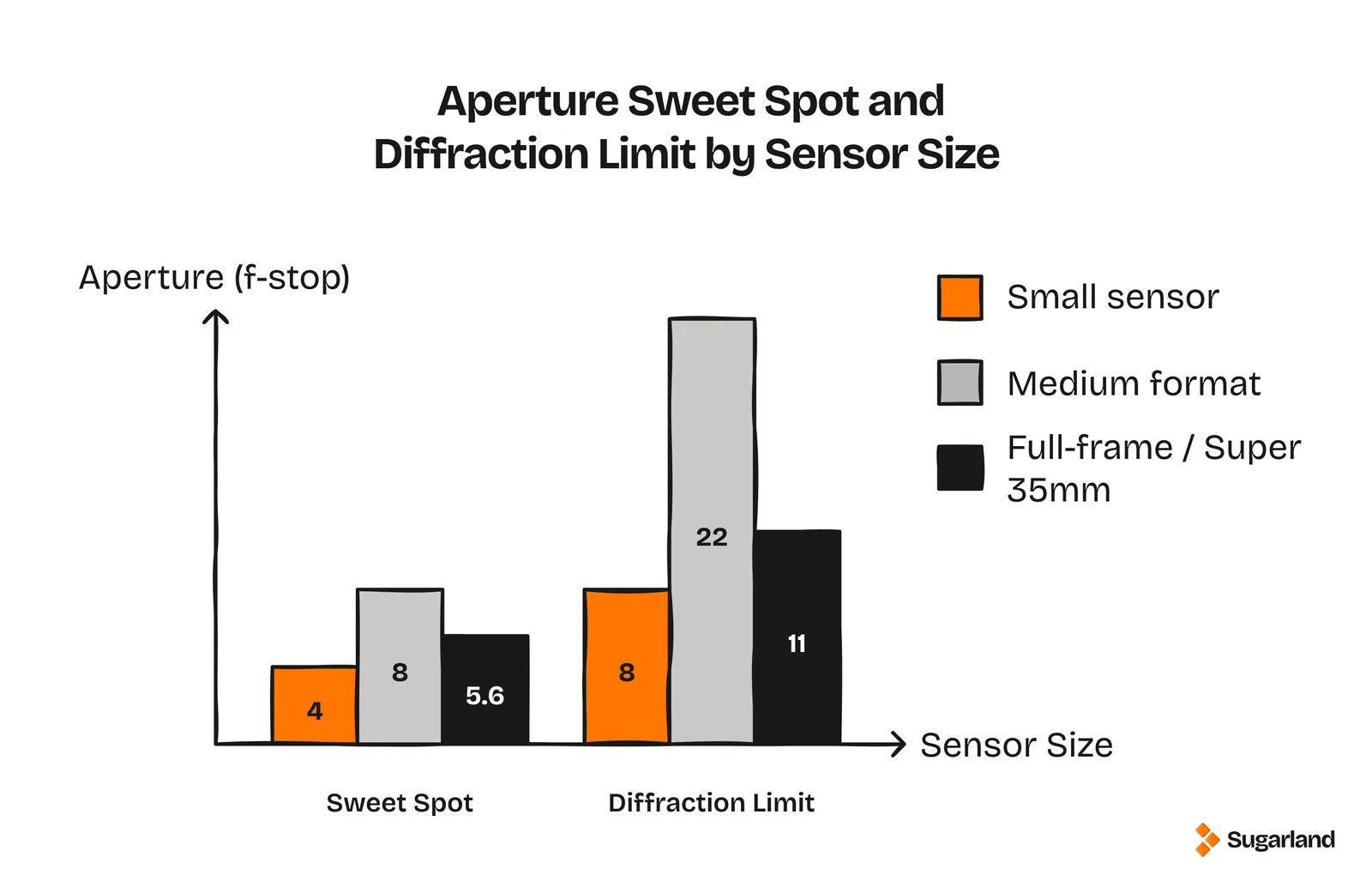
- Full-frame / Super 35mm: sweet spot starts around f/5.6, diffraction limit begins around f/11.
- Medium format: sweet spot starts around f/8, diffraction limit begins around f/22.
- Small sensor (compact, PTZ): sweet spot starts around f/4, diffraction limit begins around f/8.
That's worth bearing in mind if you're switching between formats on the same job. The aperture that's safely inside the sweet spot on one body might already be past it on another.
If you're weighing up formats for a shoot, our full-frame and Super 35mm camera ranges are worth comparing side by side before you commit to a lens set.
When Sharpest Isn't Actually What You Want
Maximum sharpness isn't always the goal, and chasing it can work against certain shots.
In portrait work particularly, a little extra softness at a wider aperture can flatter skin and soften the transition into background blur in a way that a clinically sharp sweet-spot aperture won't.
Macro work carries a similar logic, where a little softness can read as more natural than test-chart precision.
On a film set, depth of field is doing a storytelling job too. A shallow aperture that isolates a subject from a busy background might matter more to the shot than squeezing out the last percentage point of resolution.

Sharpness is one tool among several, not the only goal to optimise for.
If you're planning a shoot and want to talk through which lenses and apertures suit what you're shooting, browse our lens hire range or get in touch and we'll help you land on the right kit for the job.
The Short Version
There's no single aperture that's universally the sharpest.
What's consistent is the pattern: aberrations soften the image wide open, diffraction softens it again once you stop down too far, and the sweet spot sits somewhere in between, usually 2 to 3 stops down from maximum aperture.
Cinema lenses add T-stops into the mix for consistent exposure across a set, and sensor size shifts exactly where that sweet spot falls.
The most reliable way to know your own kit's sweet spot is still to test it yourself rather than lean on a blanket rule.
If you want to run that test before a shoot, request a quote and we'll get the right glass to you.
Let’s plan your next shoot
Get your equipment, studio and crew all in one place.