Is 35mm Film Full-Frame? Here's the Real Answer
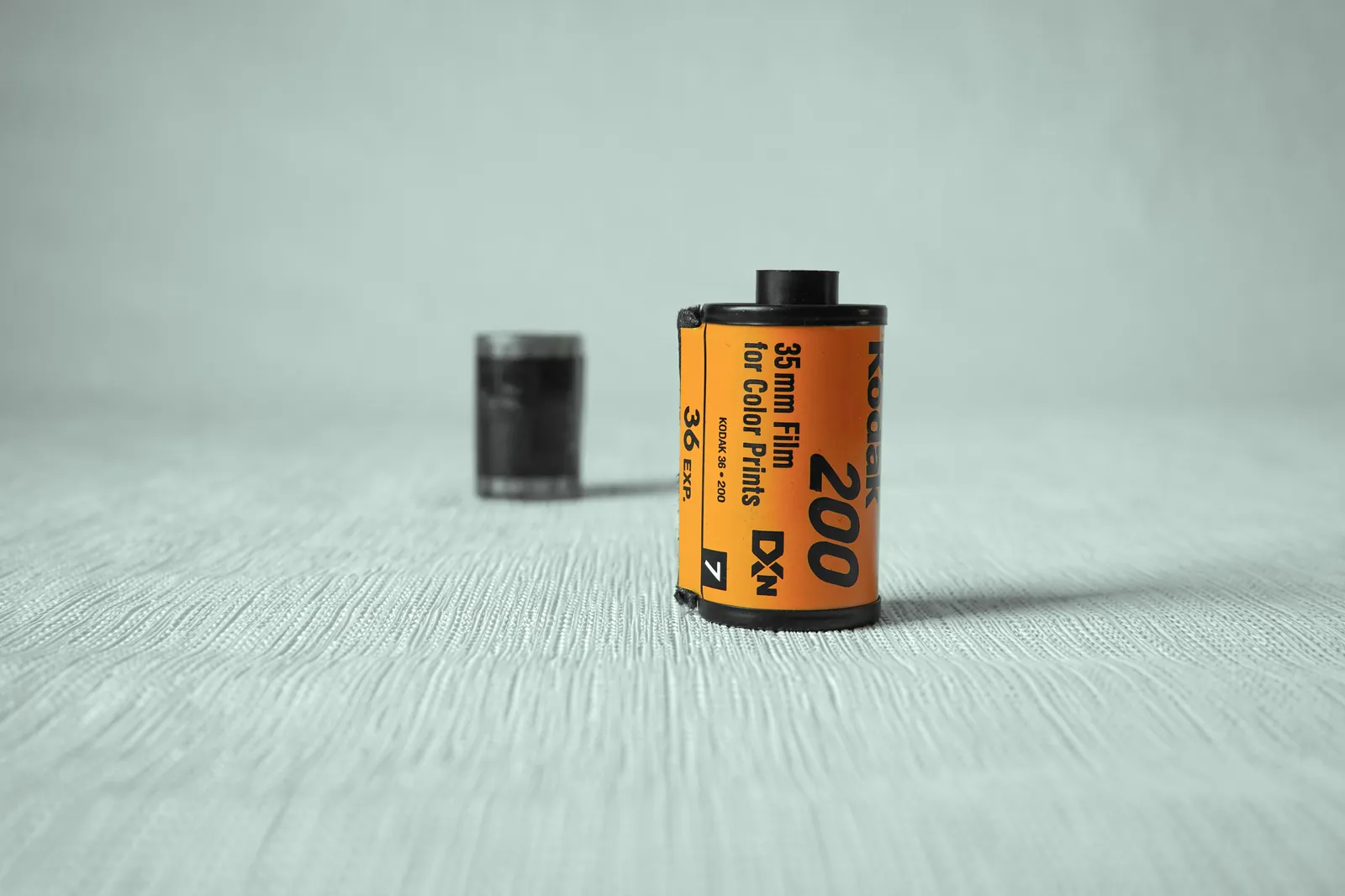
- Cinema 35mm film and still-photography 35mm film are two different formats that just happen to share a film width.
- "Full-frame" is a digital sensor term borrowed from 35mm still film (36mm x 24mm), not 35mm cinema film.
- Cinema 35mm frames are actually narrower, closer to 22-25mm wide depending on the format used.
- Full-frame sensors give a wider field of view and shallower depth of field than Super 35 at the same focal length.
If you've ever heard someone say a camera shoots "full-frame 35mm" and wondered whether that's the same 35mm film your granddad's camera used, you're not imagining things.
The terminology genuinely overlaps in a confusing way. Here's what's actually going on, and why it matters when you're choosing a camera for your shoot.
What Is 35mm Film, Really?
Cinema 35mm film is narrower than most people assume, with a frame that's actually only around 22-25mm wide depending on the specific format used.
That's because 35mm cinema film runs vertically through the camera, with four perforations along each edge holding each frame in place as it travels top to bottom.
The "35mm" name refers to the width of the film strip itself, not the width of the image on it.
Once you account for the sprocket holes and, historically, space reserved for an optical soundtrack, the actual usable image is considerably smaller than 35mm.
Standard 35mm film first appeared around 1889, and cinema cameras have run it vertically ever since.
This is the format most people picture when they hear "35mm film," and it's the one that's genuinely narrower than full-frame.
What Does "Full-Frame" Actually Mean?
Full-frame refers to a digital sensor that matches the 36mm x 24mm size of 35mm still photography film, not cinema film.
This is the format Leica introduced for stills cameras in the 1930s, where the film runs horizontally instead of vertically.
Sony explains it plainly: a full-frame sensor is defined by its size, 36mm by 24mm, tracing back to when 35mm film became the standard for stills photography and travelled sideways through the camera rather than top to bottom.
Wikipedia's definition backs this up directly: full frame refers to an image area that's the same size as a 35mm still camera's image, specifically noting that a still camera's image is significantly larger than a standard 35mm cinema camera's image.
Same film width, different orientation, different frame size.
So, Is 35mm Film Full-Frame?
No, cinema 35mm film is not the same size as a full-frame sensor.
Full-frame borrows its name and dimensions from 35mm still photography film, while cinema 35mm film is a narrower format that runs the opposite direction through the camera.
The confusion makes sense once you see where each term came from.
Both trace back to the same 35mm-wide film stock, but one measures the image running vertically (cinema) and the other measures it running horizontally (stills).
They share a name because they share a film width, not because they share a frame size.
So when someone says a modern cinema camera has a "full-frame" sensor, they're referencing the still-photography standard, not classic cinema 35mm.
It's a small distinction with a real impact on how your footage looks.
Full-Frame vs Super 35: A Quick Size Comparison
Full-frame sensors measure 36mm x 24mm, noticeably larger than Super 35, which measures around 24.89mm x 18.66mm using a 4-perf pulldown.
For reference, older Academy-format cinema 35mm comes in even smaller, at roughly 21.95mm x 16.00mm.
Academy 35mm (cinema): approximately 21.95mm x 16.00mm, from early sound-era cinema film.
Super 35 (cinema): approximately 24.89mm x 18.66mm, a 1980s reworking of 35mm cinema film.
Full-Frame (digital): 36mm x 24mm, taken from 35mm still photography film.
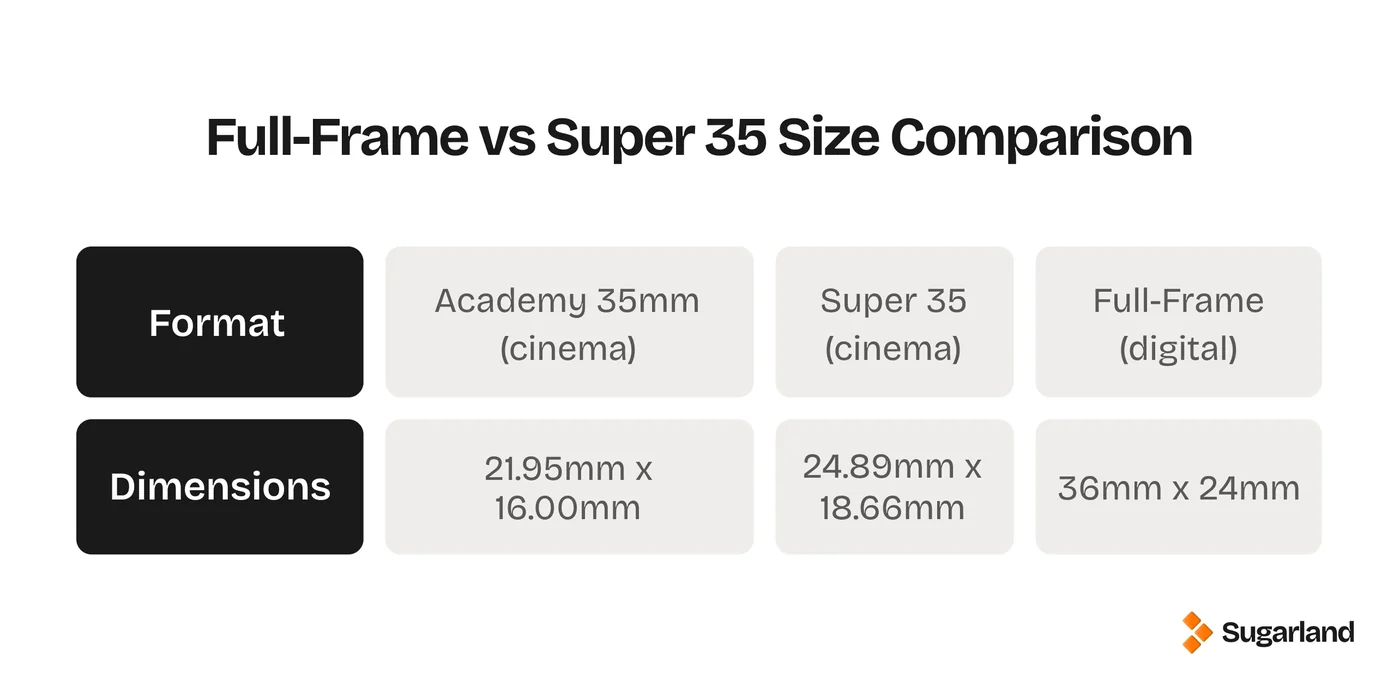
Super 35's dimensions give it around 32% more image area than Academy 35mm, but it's still well under half the surface area of a full-frame sensor.
That gap is exactly why the two formats behave so differently on set.
Does Sensor Size Actually Change Your Shot?
Yes. At the same focal length, a full-frame sensor captures a wider field of view and produces a shallower depth of field than a Super 35 sensor.
That's because the larger sensor is drawing in more of the lens's image circle.
Testing from Canon's own field applications team backs this up.
Comparing a lens on a full-format sensor versus Super 35, the full-format image showed noticeably more of the scene at the same distance and focal length, simply because it's capturing a larger slice of what the lens projects.
The practical knock-on effect is a crop factor of roughly 1.5x between the two.
A 35mm lens on Super 35 gives a field of view closer to what a 50mm lens would give on full-frame, meaning you'll often need a wider lens on Super 35 to match the same framing.
If your lens set was chosen for one format, switching to the other can change your whole shot list.
Full-Frame Cameras You Can Hire for Your Next Shoot
Full-frame isn't automatically the "better" choice, it's a different look with its own trade-offs in depth of field, lens coverage and how wide you need to go to match a Super 35 frame.
Which format suits your production depends on the story you're telling and the kit you're already pairing it with.
Sugarland stocks a solid line-up of full-frame cameras, including the Sony FX3 for lightweight, run-and-gun setups, right up to the ARRI Alexa Mini LF for high-end commercial and broadcast work.
If Super 35 is a better fit for your shoot, the Super 35mm cameras range covers that too.
Not sure which format is right for your production? Talk it through with the team and they'll help you match the camera to the shoot rather than the other way round.
FAQs
Is full-frame better than Super 35? Not inherently, they're different tools. Full-frame gives a wider field of view and shallower depth of field at the same focal length, which suits certain looks, while Super 35 has been the industry standard for decades and pairs with a huge range of existing cinema lenses.
What's the crop factor between full-frame and Super 35? Roughly 1.5x. A lens on Super 35 will frame tighter than the same lens on full-frame, so you'll typically need a wider focal length on Super 35 to match a full-frame shot.
Is 35mm still film the same as 35mm cinema film? No. They share a film width but run through the camera in different directions, which gives them different frame sizes. Still 35mm is the format full-frame sensors are named after.
Does switching between full-frame and Super 35 affect my existing lenses? It can. Lenses designed for one format may not fully cover the image circle of the other, and your effective focal length will shift due to the crop factor, so it's worth checking compatibility before you book.
Working out which format and lens set suits your shoot isn't always straightforward, especially if you're mixing cameras or coming from a different sensor size on a previous job.
Request a quote and talk it through with Sugarland before you book, so your kit list matches the look you're actually going for.
Let’s plan your next shoot
Get your equipment, studio and crew all in one place.