What Is a Steadicam Operator in Film & TV?
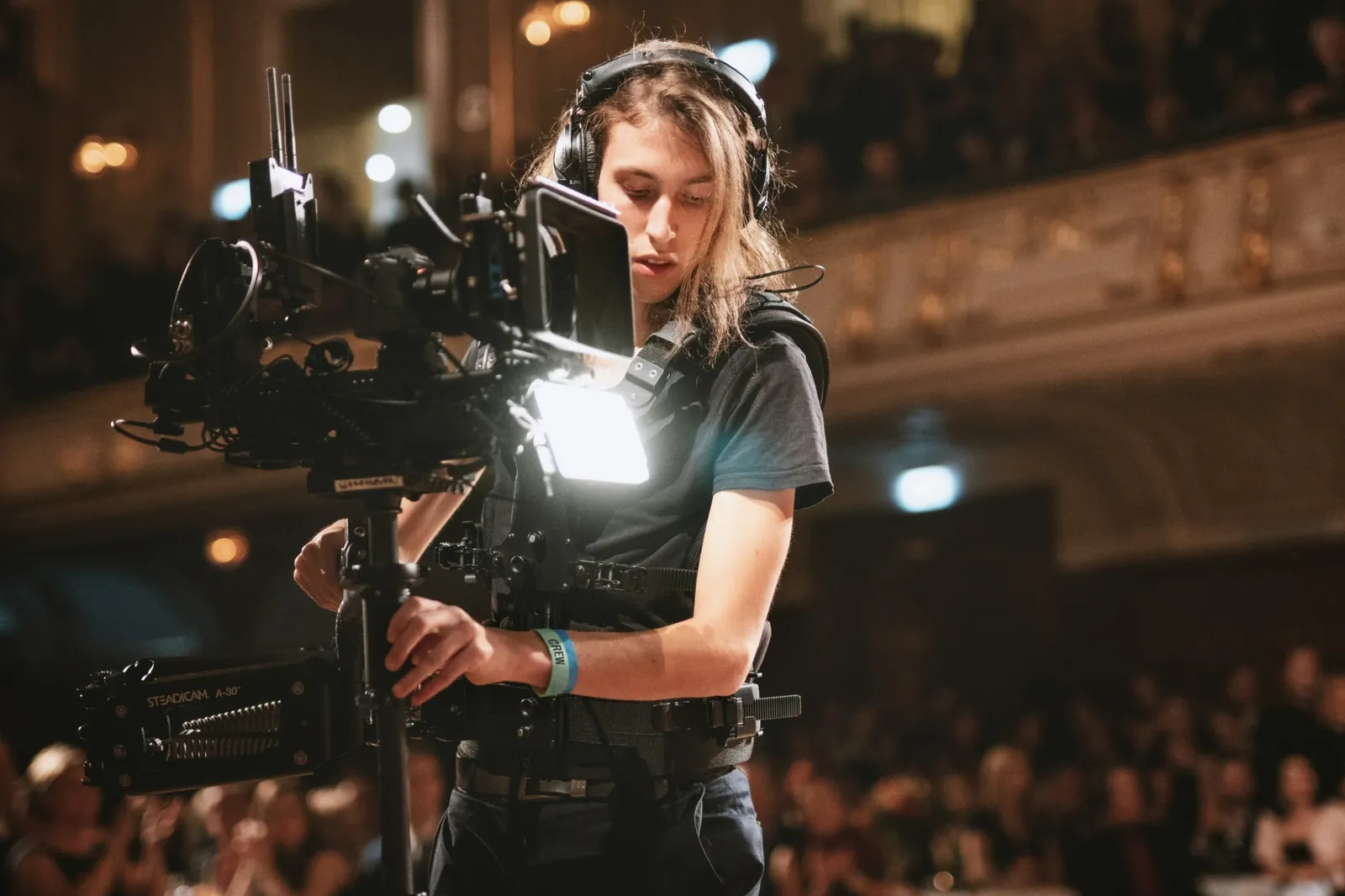
- A Steadicam operator is a specialist camera operator who wears a body-mounted rig to get smooth, moving shots on foot.
- The rig has 3 parts: a vest, a spring-loaded arm and a balanced sled that carries the camera.
- Steadicam beats a gimbal for walking bounce, stairs and long takes. A gimbal wins on setup speed and ease of use.
- For UK pay benchmarks, check Bectu's published rate cards rather than guessing.
- Booking a Steadicam operator? Give them as much notice as you can, and budget for the rig as a separate line.
You want the camera to follow your talent down a corridor, up a flight of stairs and out the front door, in one take, with no wobble.
A dolly can't climb stairs and a tripod can't walk. That's the job of a steadicam operator.
This guide covers what the role involves, how the rig works, how it compares to a gimbal and what to know before you book one.
What Is a Steadicam Operator?
A Steadicam operator is a specialist camera operator who wears a body-mounted stabilising rig to capture smooth, moving shots on foot.
Steadicam is technically a brand name, but it's become shorthand for the whole category of vest-and-arm stabilisers.
The operator frames and moves the shot the same way a camera operator would, just while walking, running or climbing.
The difference is the rig. It takes real skill to balance, and even more to fly well, which is why Steadicam operator is a role in its own right rather than something any operator picks up on the day.
What Is a Steadicam and How Does It Work?
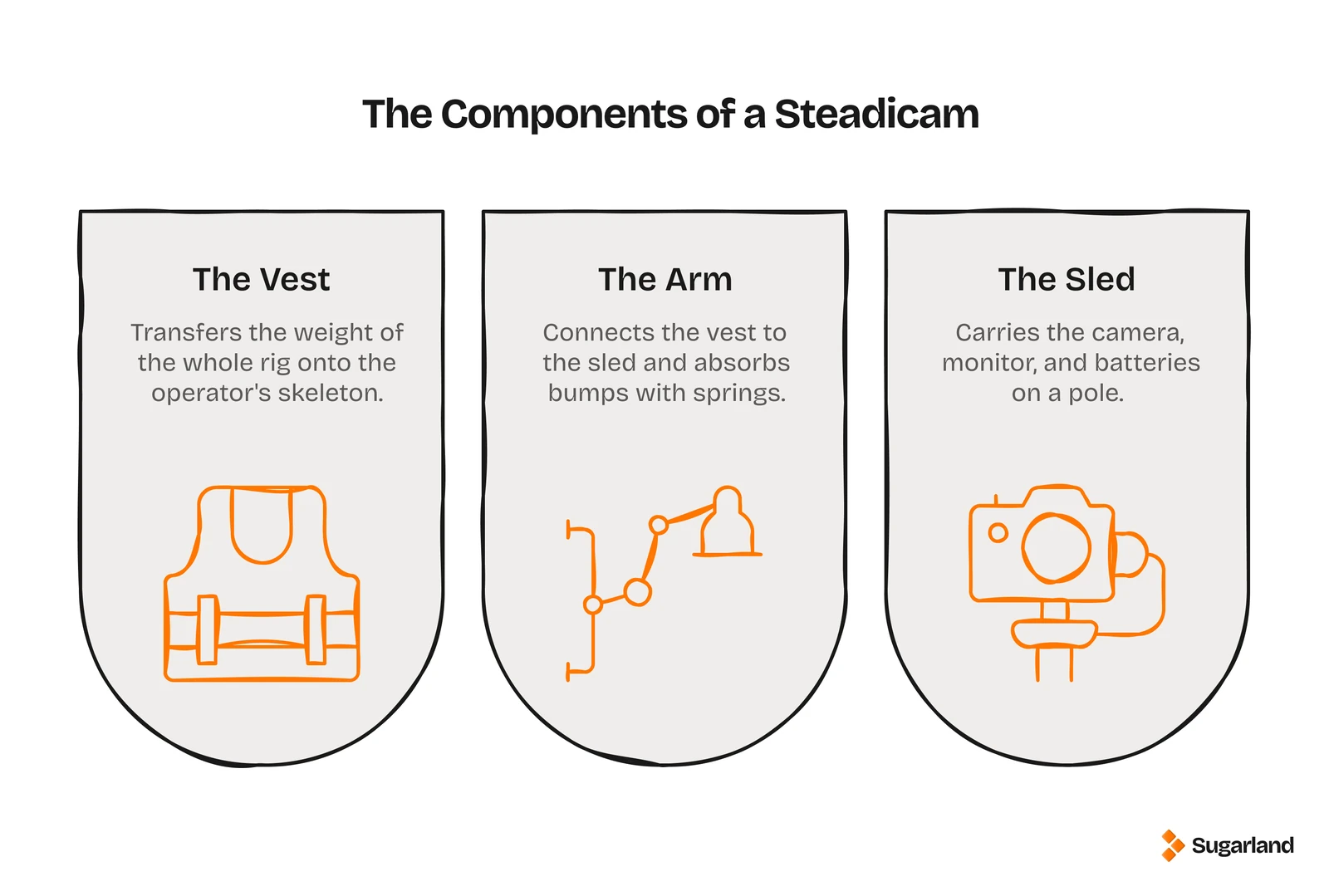
A Steadicam is a mechanical stabiliser that isolates the camera from the operator's body using a vest, an arm and a balanced sled.
There are no motors involved. It works by managing the camera's centre of gravity, so the operator's footsteps don't make it into the shot.
The Vest
The vest is what the operator wears. It transfers the weight of the whole rig onto the operator's skeleton, so their arms aren't doing the heavy lifting.
The Arm
The arm connects the vest to the sled. It works a lot like a swing-arm lamp, with springs that absorb bumps as the operator moves.
It also lets the operator raise or lower the camera for framing. On Tiffen's high-end G70x arm, that's just under 1 metre of height change.
The Sled
The sled carries the camera at one end, with the monitor and batteries at the other. A low-friction gimbal joins it to the arm.
Spreading the kit out along the sled pole moves the centre of gravity outside the camera.
That removes the small rolls, pans and tilts you'd get from handheld, and the operator steers by gently guiding the pole.
What Does a Steadicam Operator Do on Set?
A Steadicam operator sets up and balances the rig, rehearses the move with the director and cast, then operates the shot.
Balancing takes time and patience. Every change to the camera build, from a lens swap to a new accessory, shifts the balance and needs re-tuning.
Day to day, the job usually covers:
- Building and balancing the rig around the production's camera and lens package
- Rehearsing the move with the director, DOP and actors so the timing lands
- Operating the shot, framing while walking backwards, climbing stairs or moving through a crowd
- Adjusting height with the arm to hold the composition through the move
- Looking after the rig, which is often the operator's own kit
Is Steadicam Better Than a Gimbal?
Neither is better outright: Steadicam handles walking bounce, stairs and long takes better, while a gimbal is quicker to set up and easier to learn.
The gimbal is the newer tool. Motorised handheld gimbals were popularised in 2013 and only became practical once digital cinema cameras got light enough to hold at arm's length.
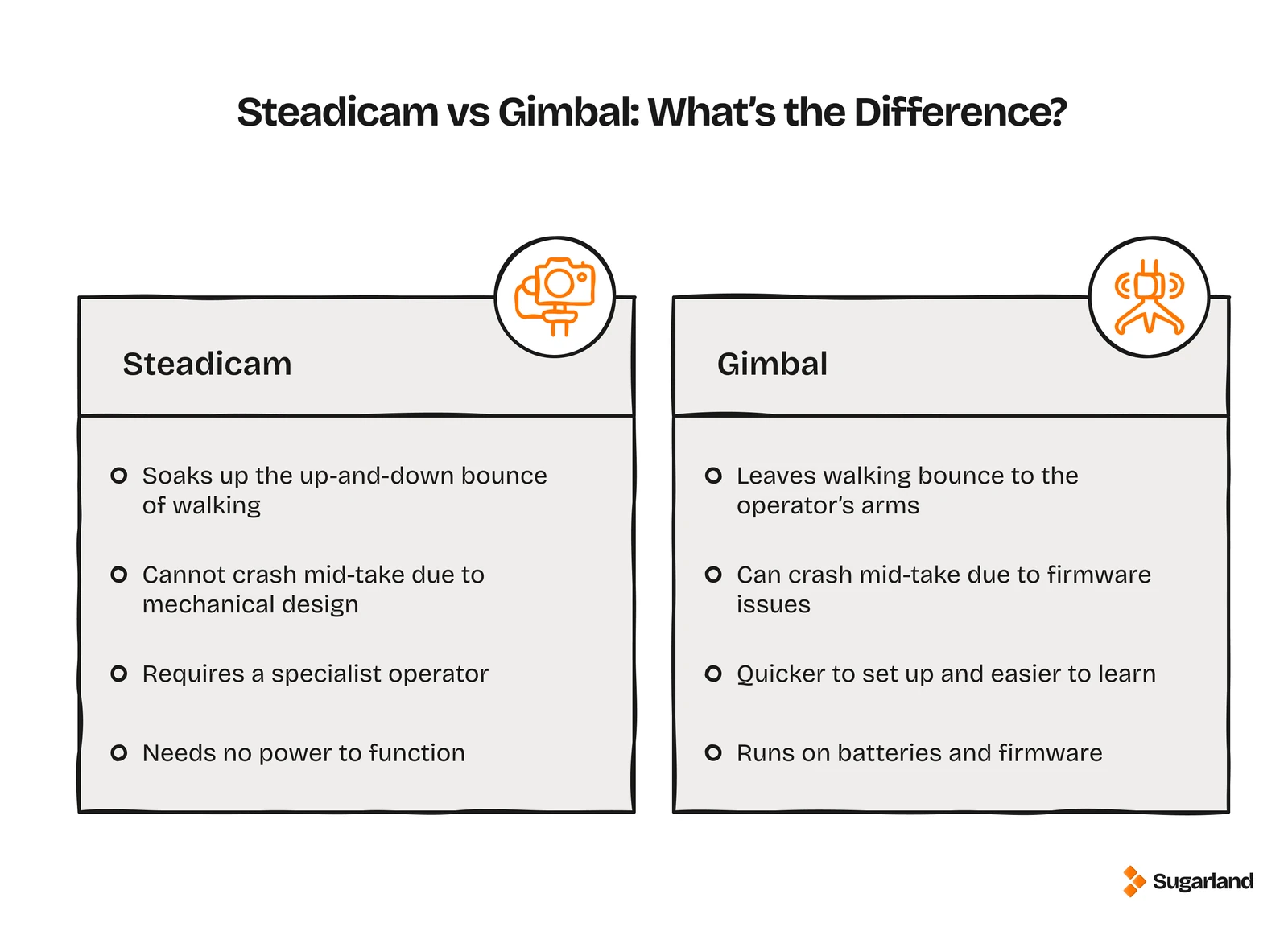
The biggest difference is vertical movement. A Steadicam's arm soaks up the up-and-down bounce of walking, while a gimbal mostly leaves that to the operator's own arms.
Here's how they compare side by side.
Steadicam
- Stabilises with counterweights, a spring arm and a mechanical gimbal
- Absorbs walking bounce through the arm
- Needs no power
- Takes longer to set up
- Needs a specialist operator
- Best for long takes, stairs and running shots
Gimbal
- Stabilises with motors and sensors
- Shows more walking bounce
- Runs on batteries and firmware
- Quicker to set up
- Easier to pick up
- Best for fast setups and lighter cameras
Being mechanical, a Steadicam also can't crash mid-take. A gimbal can, and a frozen firmware update is a very quiet way to lose an afternoon.
Rule of thumb: short shot, light camera, flat floor? A gimbal like the DJI RS4 Pro may do the job. Long take on stairs or uneven ground? That's a Steadicam job.
Do Productions Still Use Steadicam?
Yes, Steadicam is still a standard tool on high-end film and TV, and hybrid rigs now combine it with gimbal technology.
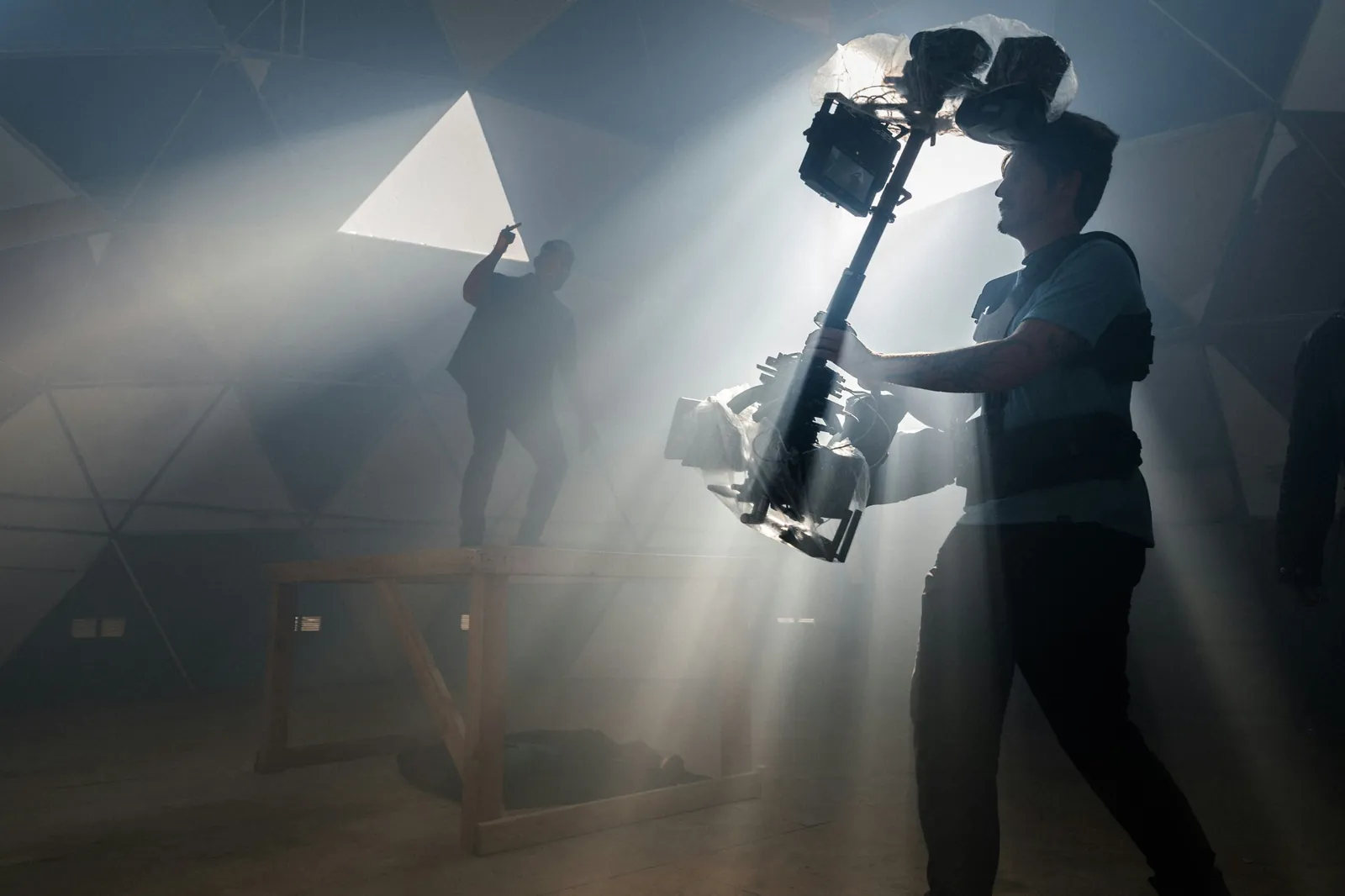
The rig was introduced in 1975 and it still turns up on sets today.
The newer twist is mounting stabilised heads on Steadicam-style arms, which gives you the fluid feel of Steadicam with more control over where the camera goes.
The best-known example is 1917. Sam Mendes wanted the film to play as one continuous shot, and Roger Deakins chose the ARRI Trinity as one of 4 core rigs to move the camera.
Its operator, Charlie Rizek, summed up the appeal:
"It builds on the fluidity a traditional Steadicam would give you." Charlie Rizek, Trinity operator on 1917
The rest comes from the precision of a remote head, which lets the operator place the camera almost anywhere around them.
Famous Steadicam Shots in Film
Steadicam went from prototype to cinema history in a single year. Inventor Garrett Brown operated the rig himself on its first 3 features, all in 1976.
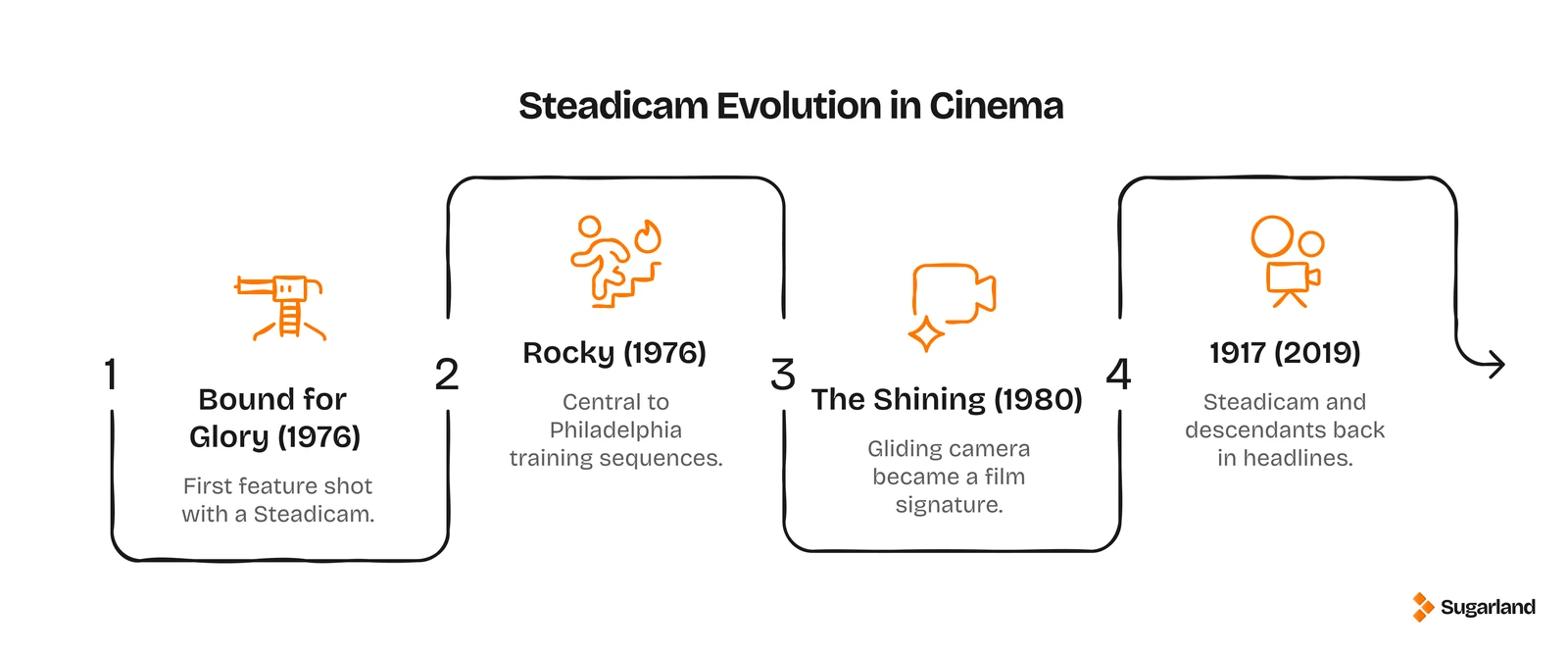
Bound for Glory (1976)
This was the first feature shot with a Steadicam. Brown started the shot on a raised crane platform, stepped off as it reached the ground and walked the camera straight through the set.
Fun detail: it was the first film shot with Steadicam, but not the first released. Marathon Man and Rocky both beat it to cinemas.
Rocky (1976)
Steadicam was central to Rocky's Philadelphia training sequences, including the run up the Art Museum steps. It's hard to picture that scene on a dolly.
The Shining (1980)
Stanley Kubrick brought Brown in for The Shining, and the pair worked closely together on how to use the rig. The gliding camera became one of the film's signatures.
1917 (2019)
1917 brought Steadicam and its descendants back into the headlines.
Alongside Trinity operator Charlie Rizek, the camera team included UK operator Peter Cavaciuti, a Steadicam operator since 1984.
How Much Do Steadicam Operators Get Paid in the UK?
Steadicam operator pay depends on experience and the type of production, and the most reliable UK benchmark is Bectu's published rate cards.
Bectu publishes camera rate cards covering film and TV drama, plus factual and outside broadcast.
They're updated regularly, so check the latest version rather than relying on figures quoted elsewhere.
Two things to keep in mind when you budget:
- Labour and kit are different lines. Many Steadicam operators own their rig, so check what a quote covers.
- Rates vary by production type. A feature, a TV drama and a live broadcast can all sit on different scales.
To build out the rest of your crew budget, our crew cost calculator works from published Bectu rate cards by role and department.
How to Become a Steadicam Operator
There's no formal qualification for becoming a Steadicam operator.
Hands-on experience and skill are what count, and most people follow a career path up through the camera department first.
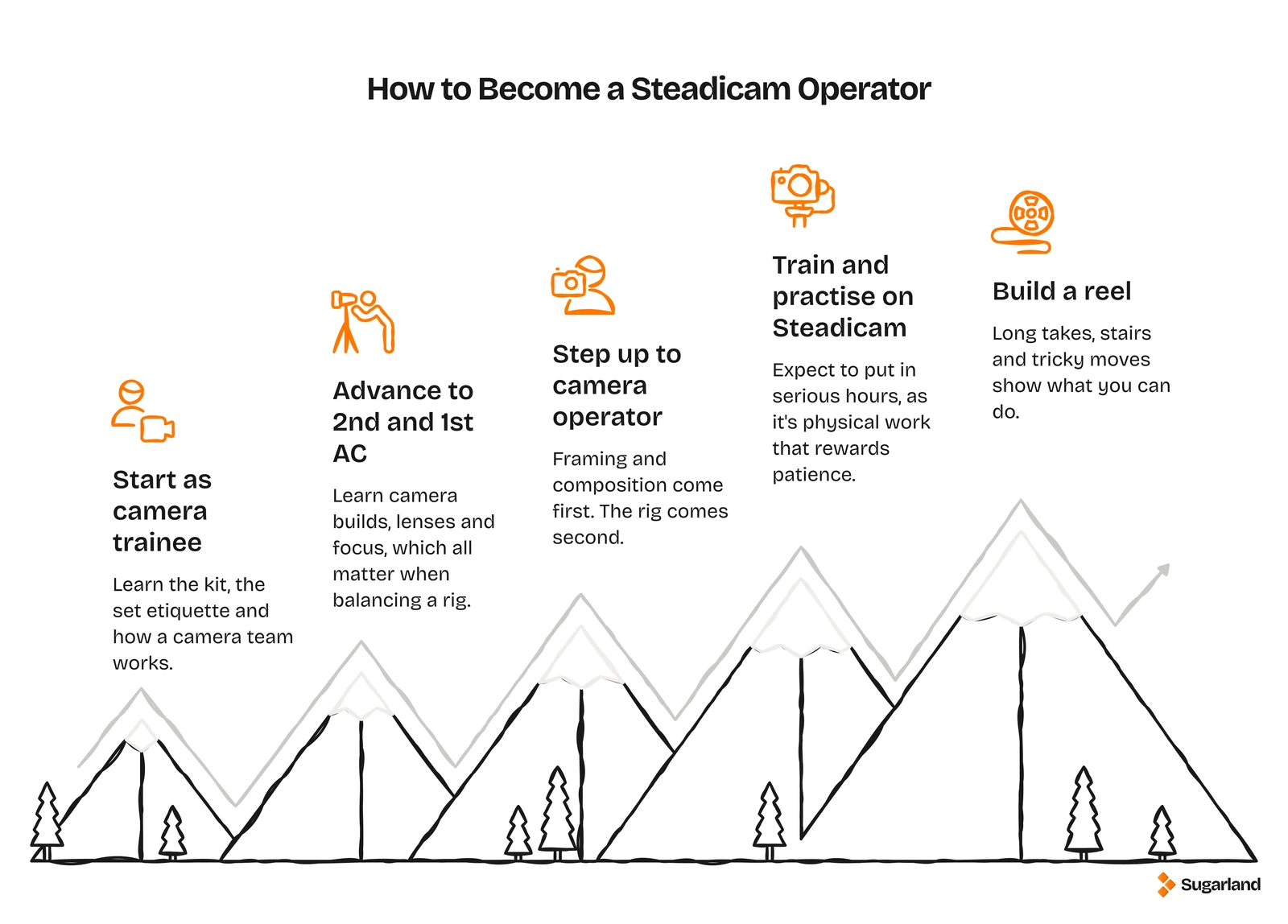
- Start as a camera trainee. Learn the kit, the set etiquette and how a camera team works.
- Move up to 2nd AC, then 1st AC. You'll learn camera builds, lenses and focus, which all matter when balancing a rig.
- Step up to camera operator. Framing and composition come first. The rig comes second.
- Train and practise on a Steadicam. Expect to put in serious hours, as it's physical work that rewards patience.
- Build a reel. Long takes, stairs and tricky moves show what you can do.
Hiring a Steadicam Operator for Your Shoot
If your shot plan includes a long take, stairs, uneven ground or a walk-and-talk that a dolly can't follow, it's worth booking a dedicated Steadicam operator.
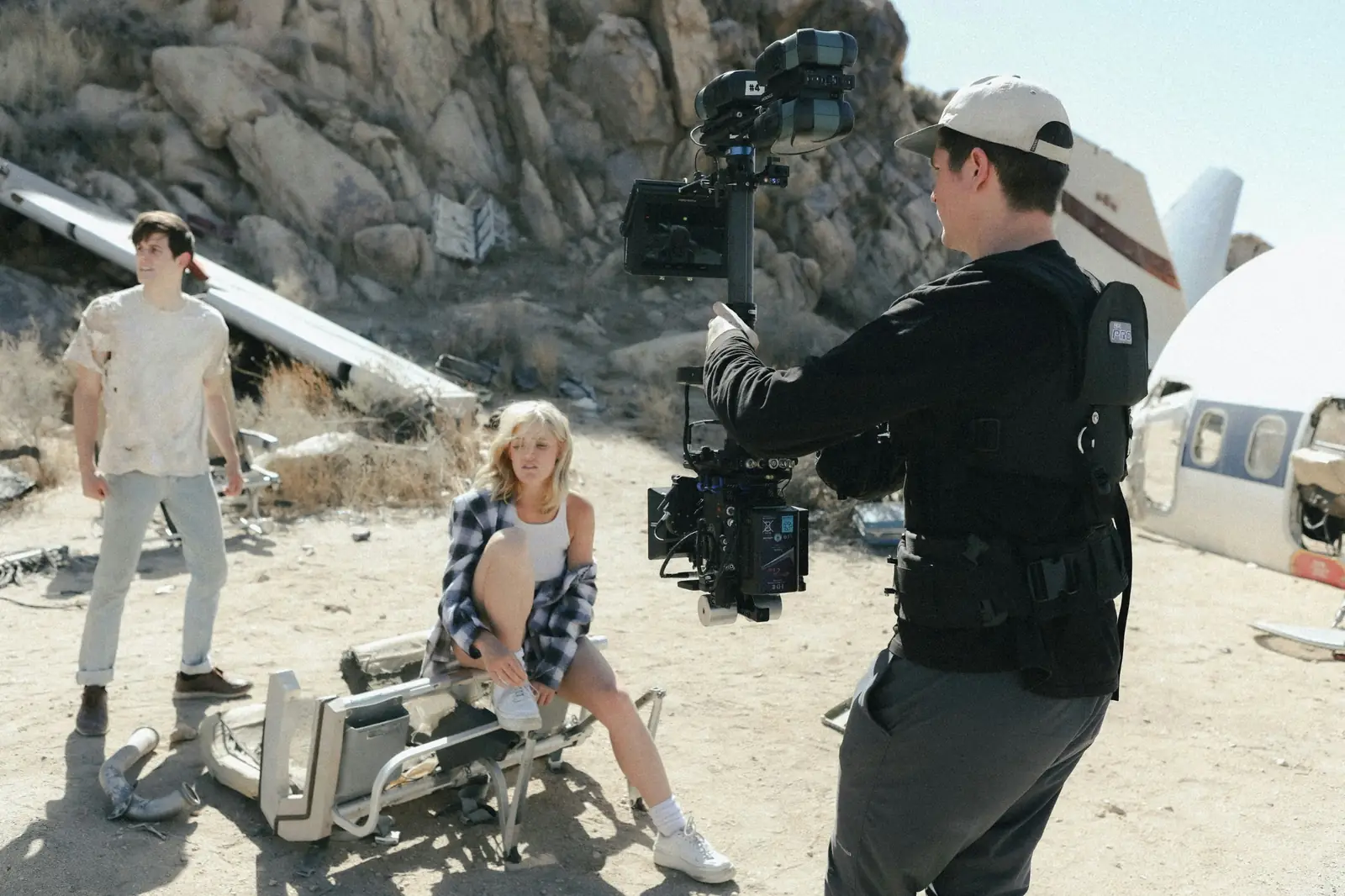
Sugarland supplies Steadicam operators through our crew hire service.
Our crew are freelance, so availability depends on who's free on your dates. More notice genuinely helps.
A few things to know before you book:
- Equipment is quoted separately. The Steadicam rig and any other kit are quoted and billed separately from the operator.
- Travel and meals are paid by the client, not included in the crew rate.
- Share your camera and lens package early. The rig is balanced around it, so changes on the day cost time.
- Send the shot list and locations. Floor surfaces, stairs and distances all shape the plan.
We've been running since 1997 as a family business, founded by a former cameraman.
We source crew from people we've worked with for years, and because we cover kit, studio and crew under one roof, you can book the operator, camera and support kit in one go.
Ready to plan your shoot? Request a quote and tell us what the shot needs to do.
Steadicam Operator FAQs
Is It Hard to Be a Steadicam Operator?
Yes, it's one of the more demanding camera roles. It combines operating skill with the physical strain of wearing a heavy rig for long takes, and balancing it well takes years of practice.
Who Invented the Steadicam?
Garrett Brown invented the Steadicam, and it was introduced in 1975. He went on to operate it on Bound for Glory, Rocky and The Shining.
Can a Steadicam Shoot Low-Angle Shots?
Yes. The sled can be flipped so the camera sits at the bottom with the monitor and batteries on top, which is known as low mode.
Let’s plan your next shoot
Get your equipment, studio and crew all in one place.