Sony FX3 vs FX5: What Is the Difference?
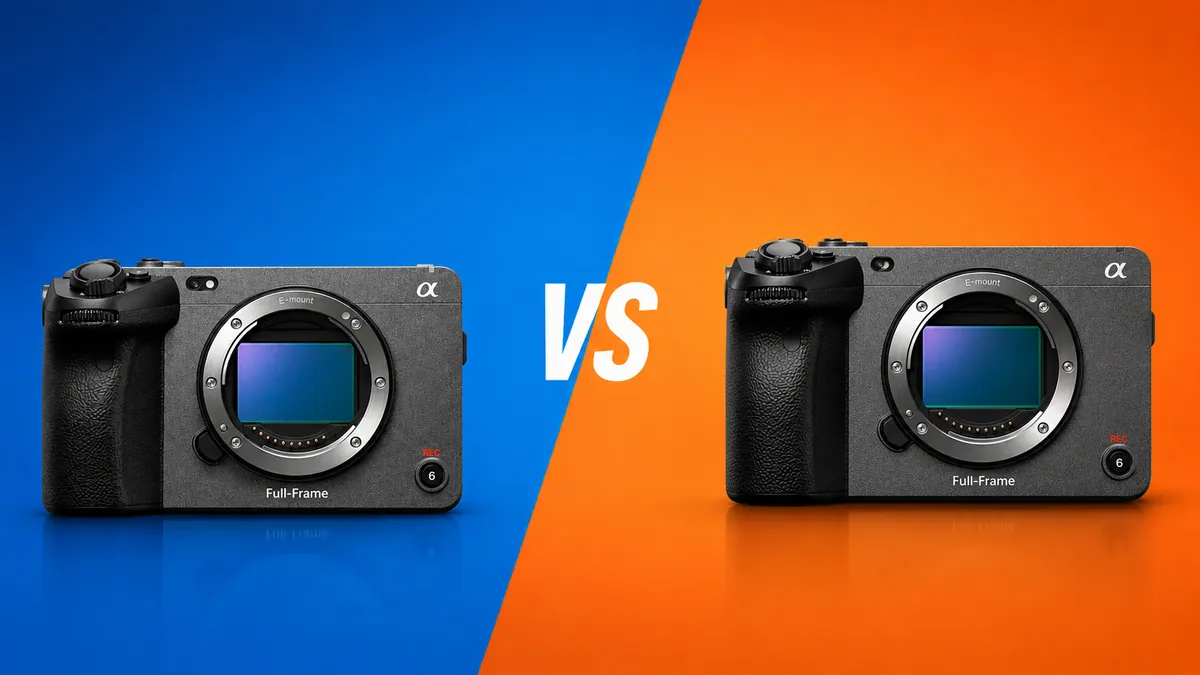
- The Sony FX5 is the newest camera in Sony's FX lineup, slotting in between the FX3 and FX6.
- It brings a new stacked sensor, triple base ISO, Open Gate recording and internal RAW, none of which the FX3 offers.
- The FX3 keeps a dual base ISO, tops out at 4K and doesn't shoot internal RAW, but it's a proven, compact workhorse.
- Choose based on whether your shoot needs Open Gate and RAW flexibility, or whether reliable 4K is all you need.
If you're trying to work out what is the difference between the FX3 and FX5, the short version is this: the FX5 is Sony's newest Cinema Line camera, and it closes the gap between the FX3 and the FX6 with a genuine spec bump, not just a name change.
We've just brought the FX5 into stock, and the FX3 has been our most popular camera for a good while now.
This guide breaks down exactly what's changed, so you know which one your shoot actually needs.
What Is the Sony FX5?
The Sony FX5 is the latest addition to Sony's Cinema Line, announced in July 2026.
It combines the compact form factor of the FX3 with some of the capability of the higher-end FX6, and it slots between the two in Sony's own lineup.
It's built around a newly developed sensor and processor, and it introduces features to the FX series that weren't available on the FX3 at all.
FX3 vs FX5: The Key Differences at a Glance
The headline differences come down to sensor, recording formats and autofocus. Here's how the two compare side by side.
Sensor
- FX3: 12.1MP full-frame Exmor R
- FX5: 16.6MP full-frame stacked Exmor RS (new)
Base ISO
- FX3: Dual (800 / 12,800)
- FX5: Triple (800 / 4,000 / 12,800)
Dynamic range
- FX3: 15+ stops
- FX5: 15+ stops (before Dual Gain Shooting)
Max recording
- FX3: 4K up to 120fps, no internal RAW
- FX5: 5K Open Gate up to 60fps, 4K up to 120fps, internal X-OCN RAW
Stabilisation
- FX3: 5-axis IBIS
- FX5: Improved IBIS with Dynamic Active mode
Autofocus
- FX3: Human subject detection
- FX5: AI tracking for humans, animals and birds
Screen
- FX3: 3in, 1.44 million dot
- FX5: 3.5in, 4-axis multi-angle, with waveform, false colour and vectorscope
Day rate
- FX3: £100/day +VAT
- FX5: £150/day +VAT
These figures come from Sony's own launch specifications and independent testing, and the side by side breakdown confirms the FX5 as a step up across nearly every category rather than a like-for-like swap.
Sensor and Image Quality
The FX5's new stacked sensor is where most of the practical improvement comes from.
Where the FX3 runs a dual base ISO at 800 and 12,800, the FX5 adds a third anchor point at 4,000, giving it a cleaner image in the dusk and indoor lighting range that used to fall between the FX3's two settings.
Cinematographer Claudio Miranda, ASC, tested the FX5 against Sony's flagship VENICE 2 as a benchmark and found the FX5 delivers a smoother, more organic image than the FX3, particularly in highlights, deep shadows and skin tones.
That's a meaningful jump for a camera in this size and price bracket, and it's the kind of image quality difference you'd usually only see by stepping up to a much larger body.
Open Gate and Internal RAW Recording
This is the biggest functional gap between the two cameras. The FX3 can't shoot internal RAW and doesn't offer Open Gate recording at all.
The FX5 can do both: it shoots 5K Open Gate at up to 60fps and records internal X-OCN raw, a 16-bit format that gives editors far more room to correct white balance, adjust highlights and grade footage in post.
On the technical side, X-OCN LT runs at roughly 389 Mbps at 4K 24p, comparable to XAVC S-I but with the extra grading latitude RAW provides.
Sony has also confirmed a firmware update planned for 2027 that will extend Open Gate recording further, so the FX5's feature set is set to grow after launch rather than stay fixed.
What Does Open Gate Actually Mean for Your Shoot?
Open Gate means the camera records using the full sensor area rather than cropping to a fixed aspect ratio.
In practice, that gives you one master file you can reframe into 16:9 for broadcast, 9:16 for social, or anything in between, without reshooting or losing resolution.
If your production needs to deliver the same shoot across multiple platforms, that flexibility alone can save a genuine amount of time in the edit.
Autofocus, Stabilisation and Handling
The FX3 uses Sony's older subject detection system, tracking human subjects reliably but without the broader recognition found on newer bodies.
The FX5 adds an AI processing unit that extends tracking to humans, animals and birds, alongside an improved in-body stabilisation system with a Dynamic Active mode for handheld and gimbal work.
The FX5 also gets a larger, 4-axis multi-angle touchscreen with waveform, false colour and vectorscope built in, tools that were previously the preserve of larger cinema bodies.
For a solo shooter working without a full monitoring setup, that's a real practical advantage on set.
Which One Should You Hire, FX3 or FX5?
Honestly, the FX3 has been our most hired camera for a good while now, and it's easy to see why.
It's compact, reliable, and does everything most productions need without any fuss.
We've written before about why it's still worth it even with newer bodies on the market, and that still holds true for straightforward 4K work.
That said, we brought the FX5 in because it fills a real gap between the FX3 and the FX6, and we think it could take over as our most popular hire before too long. It's not a replacement for the FX3 so much as a genuine step up for productions that need more from the image, more flexibility in post, or better autofocus on a run and gun shoot.
If you want the full picture on the FX3 itself, our FX3 guide covers what it's good for in more detail.
Is the Sony FX5 Worth Hiring Over the FX3?
Yes, if your shoot needs Open Gate flexibility, internal RAW, or better low-light and autofocus performance, the FX5 is worth the jump.
The FX3 remains a solid, tested choice if you just need dependable 4K and want to keep costs tighter.
Both cameras are proven parts of Sony's Cinema Line rather than one being an outright replacement for the other, so the right pick comes down to what your production actually needs from the image.
If you want a closer look at the FX5's full feature set, our FX5 guide goes into more detail, or you can request a quote and we'll help you match the camera to the shoot.
Let’s plan your next shoot
Get your equipment, studio and crew all in one place.