Sony Power Zoom Lens Guide: What It Is and When to Hire One
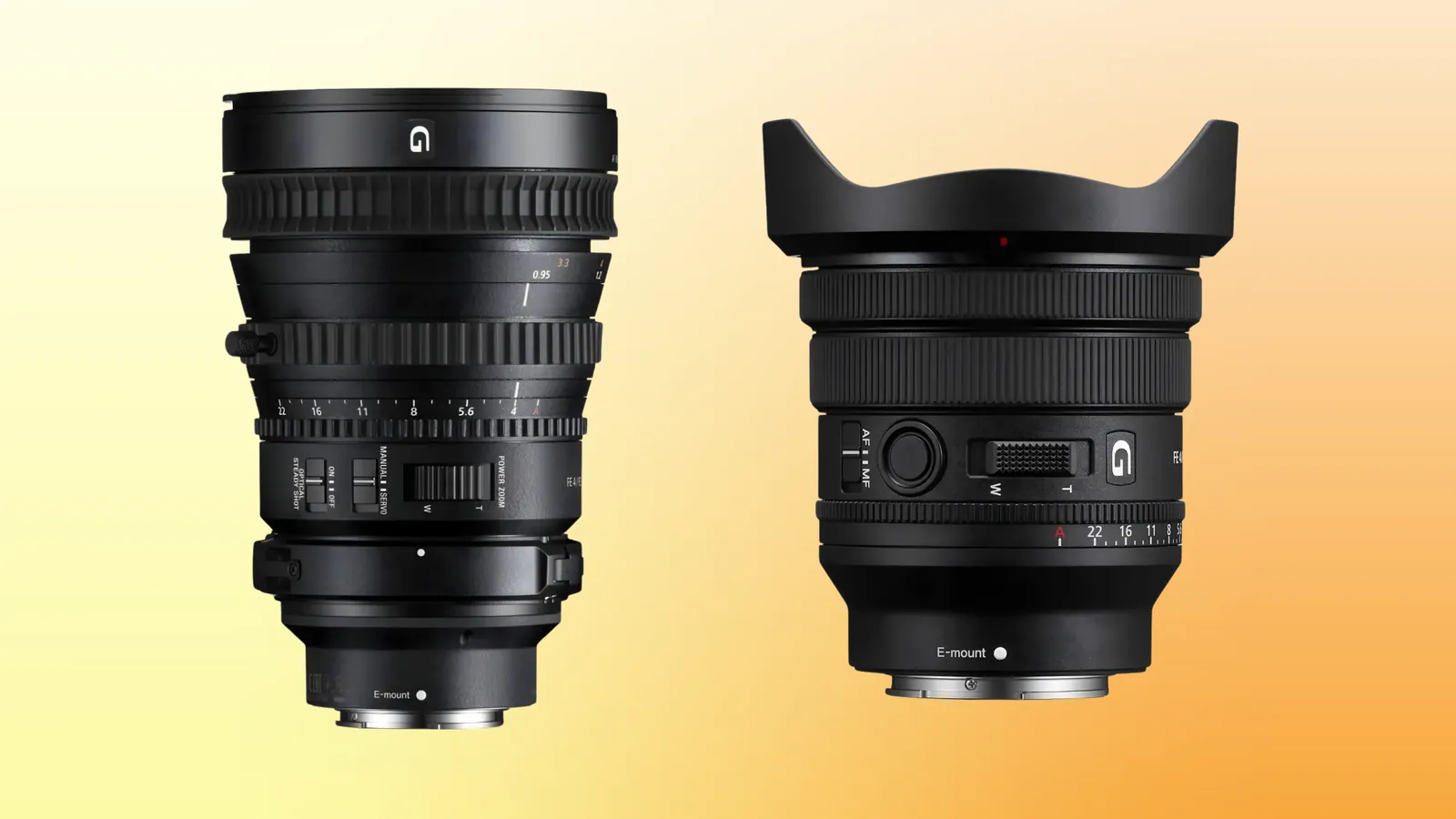
- A power zoom lens uses a motor to zoom, so your zooms stay smooth and steady without turning a ring.
- The Sony FR7 needs a power zoom lens for remote zoom. A manual zoom lens loses it.
- We hire out 2 Sony power zoom lenses: the FE PZ 28-135mm f/4 G OSS for reach and the FE PZ 16-35mm f/4 G for wide, light setups.
- Both mount on all 4 FX bodies we stock (FX3, FX5, FX6 and FX9) as well as the FR7.
- If you're next to the camera and can zoom by hand, a manual zoom is usually the better pick.
Some cameras sit where nobody can reach the lens while it's rolling. A Sony power zoom lens solves that.
We hire out 2 of them, so here's how they work, which Sony lenses have the feature and when you actually need one.
What Is a Power Zoom Lens?
A power zoom lens uses a motor to change focal length, so you don't turn a ring by hand.
It's a motor-assisted zoom that keeps its speed smooth and steady from start to finish.
Sony puts "PZ" in the name of these lenses.
Depending on the lens and camera, you control the zoom with a rocker on the lens, a control on the camera body or a remote.
Power Zoom vs Manual Zoom: What's the Difference?
The difference is what moves the zoom: a motor on a power zoom, your hand on a manual zoom.
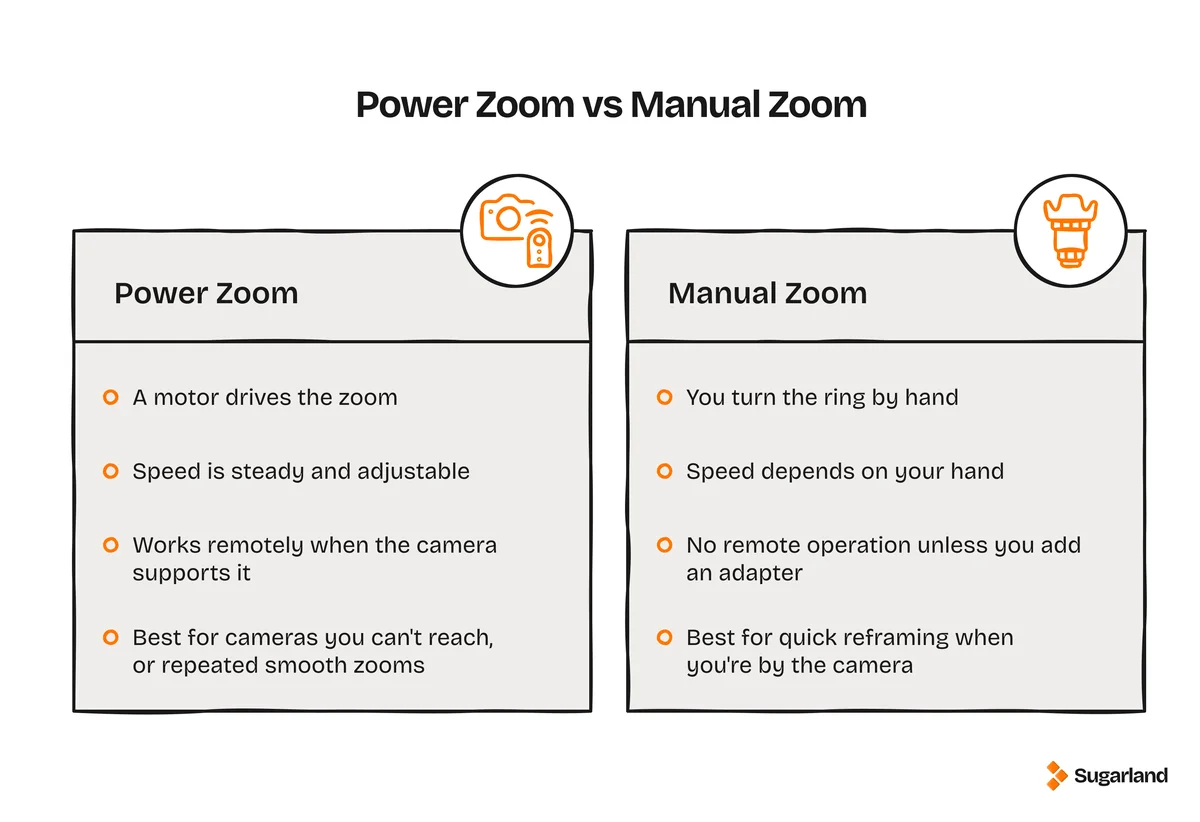
Power zoom:
- A motor drives the zoom
- Speed is steady and adjustable
- Works remotely, when the camera supports it
- Best for cameras you can't reach, or repeated smooth zooms
Manual zoom:
- You turn the ring by hand
- Speed depends on your hand
- No remote operation, unless you add an adapter
- Best for quick reframing when you're by the camera
Neither is better across the board. Photographers often prefer the precision of a manual ring, while a power zoom is a real advantage on fast-moving video work like documentary, news and sport.
It comes down to where the camera sits and who's operating it.
Which Sony Lens Has Power Zoom?
Sony makes several E-mount power zoom lenses, and 2 of them are on our shelves. The power zoom range splits like this:
- Full-frame: FE PZ 28-135mm f/4 G OSS and FE PZ 16-35mm f/4 G
- APS-C: E PZ 18-105mm f/4 G OSS, E PZ 18-200mm f/3.5-6.3 OSS and E 16-50mm f/3.5-5.6 PZ OSS
Our 2 are both full-frame.
Sony FE PZ 28-135mm f/4 G OSS: The Reach Option
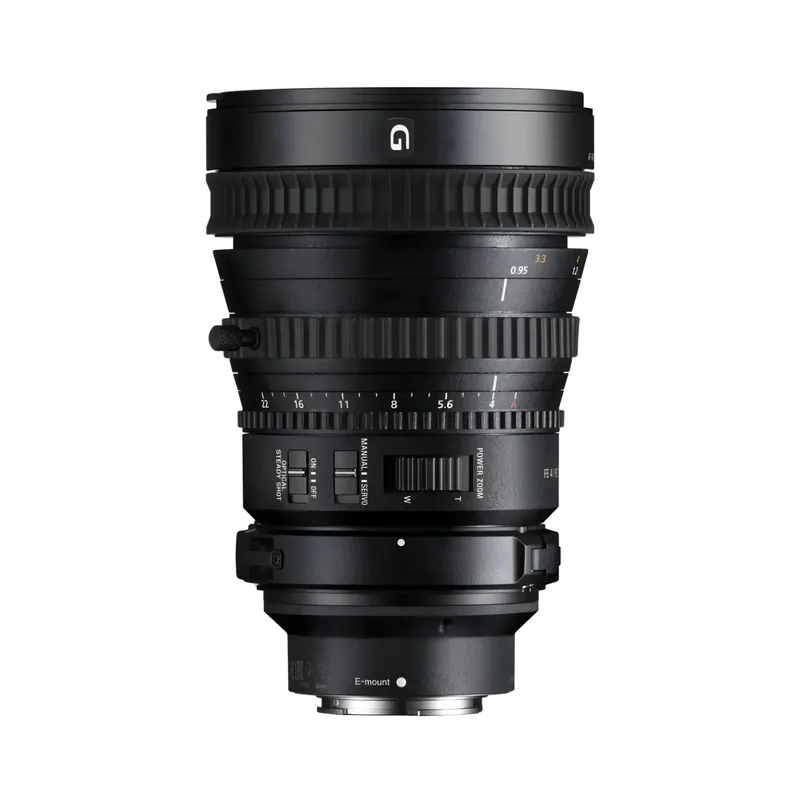
Our 28-135mm covers wide to telephoto in 1 lens, so you're not stopping to change glass.
- Ring or rocker: A switch on the lens flips between the manual ring and a rocker lever for power zoom.
- Constant f/4 aperture: Exposure stays put as you zoom from 28mm to 135mm.
- Optical stabilisation: Built-in OSS helps on handheld and rig work.
- Weight and size: 1,215g with a 95mm filter thread, so it's the heavier of our 2 power zooms.
- Close focus: 0.40m minimum focus distance.
Pick it when you need range, or when the camera sits a long way from the action.
Sony FE PZ 16-35mm f/4 G: The Wide, Light Option
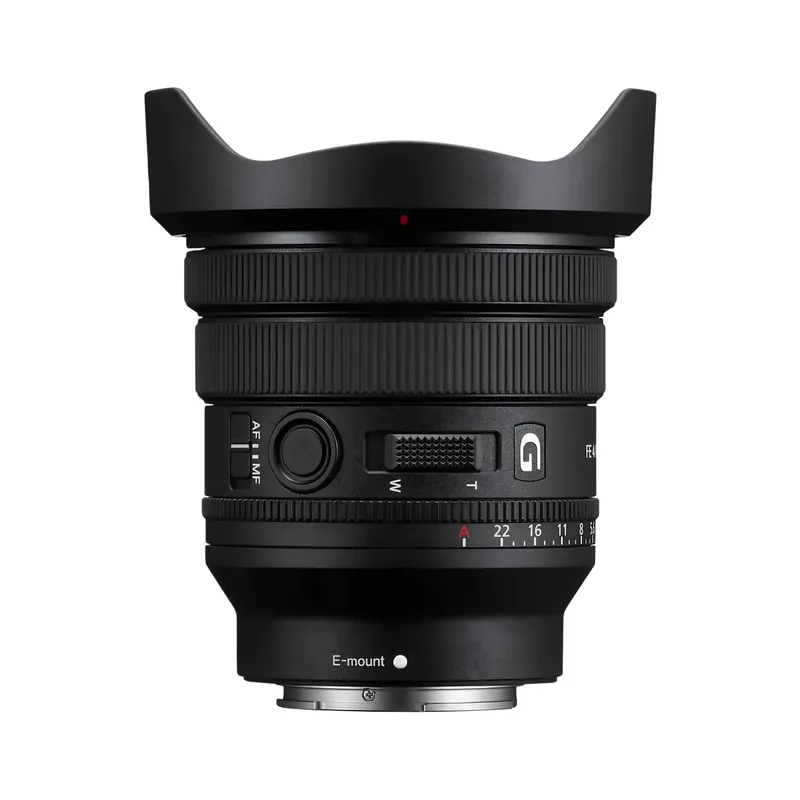
Our 16-35mm PZ is the lighter, wider option. It suits small rigs and setups where weight matters.
- Constant f/4: The constant f/4 aperture doesn't change as you zoom.
- 8 zoom speeds: On bodies like the FX3, you pick the speed from the menu.
- Separate speeds: You can set separate speeds for framing and recording, so you frame quickly and record slowly. Sony also offers a physical remote and a mobile app for zooming.
- Light and compact: 353g and 80.5mm x 88.1mm.
It's also the lens in the story below.
What Shoots Suit a Power Zoom Lens?
Shoots where the camera is out of reach, the crew is small or the zoom needs to stay smooth suit a power zoom lens.
We've hired ours for:
- Live events
- Fashion shows
- Remote shows, such as prank shows
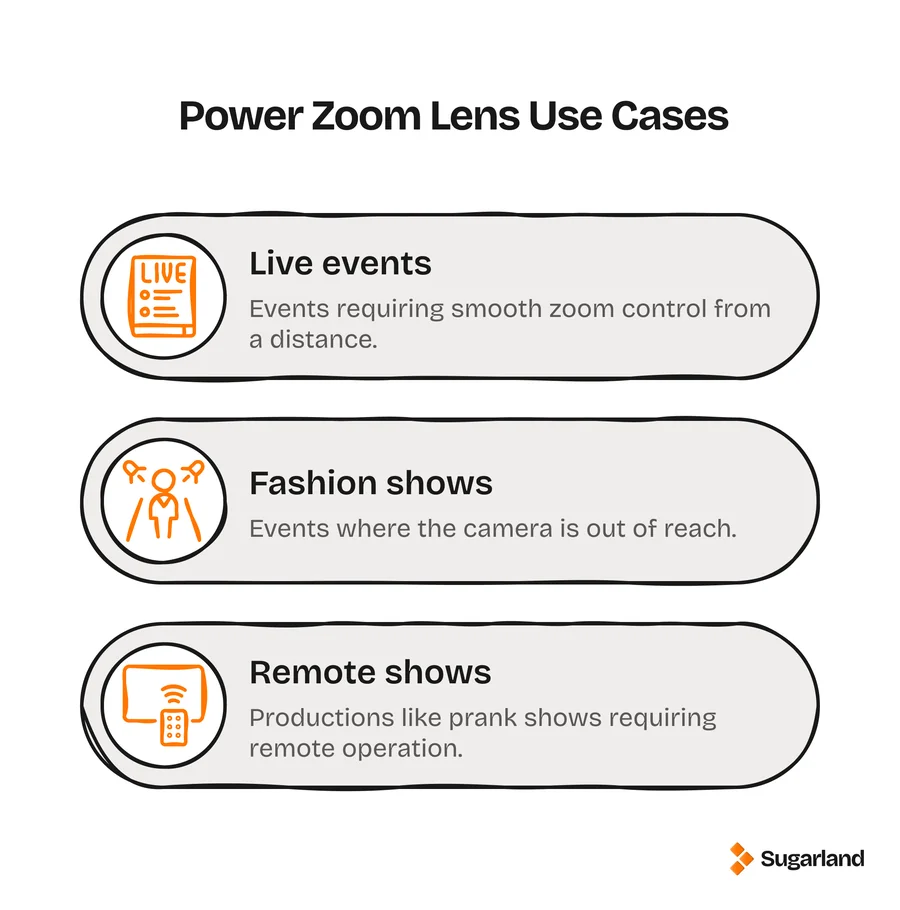
In those setups, the camera is often somewhere nobody can reach the lens.
Most go out alongside the Sony FR7, because it isn't a handheld camera. Someone has to operate the zoom from somewhere else.
How Do You Zoom a Camera You Can't Reach?
You zoom it remotely, and that only works properly if the lens has a power zoom motor.
The Sony FR7 is a good example. For full remote pan, tilt and zoom, it has to be paired with a power zoom lens.
It will take a manual zoom lens, but you lose the remote zoom.
You then run the zoom from a controller. The RM-IP500 handles pan, tilt and zoom on the FR7 with a joystick or seesaw lever.
We hire out the Sony RM-IP500 if you need one.
One job comes to mind.
A client asked for the Sony 16-35mm G Master on an FR7. We steered them to the 16-35mm PZ instead, because it has remote zoom control.
The G Master would have needed a zoom adapter to get the same result. Plenty of people don't realise that about the FR7 until they're building the kit list.
Adapters do exist. Chrosziel makes a zoom servo drive for the FR7 that motorises the zoom ring on a range of Sony E-mount zooms, including G Master lenses.
It mounts on 15mm rods and takes its power from the camera.
We can source it in for you, so you still deal with 1 point of contact. That's a good route if you specifically want a G Master on an FR7.
For most jobs, though, we'd put a power zoom lens on the camera and skip the extra rigging.
When Is a Manual Zoom Better Than a Sony Power Zoom Lens?
A manual zoom is better when you're next to the camera and can operate the zoom yourself.
I'd steer you that way in those cases. A motor adds nothing when your hand is already on the ring.
Our G Master lens zooms are f/2.8, which is 1 stop faster than the f/4 on both power zooms. That helps in low light.
Not sure which way to go? Tell us where the camera sits and who's operating it, and we'll recommend the lens.
Which Camera Bodies Work With Sony Power Zoom Lenses?
Both lenses work on all 4 FX bodies we stock (FX3, FX5, FX6 and FX9) and on the FR7, because they're all E-mount.
The 28-135mm has a rocker on the lens itself. On the FX3, FX6 and FX9 you can also zoom from the body, thanks to the zoom controls on those cameras.
The FR7 works differently. It's built for remote control, so the zoom runs from a controller or the web app rather than from the camera.
Hiring a Power Zoom Lens From Sugarland
Hiring one takes 3 steps:
- Request a quote by form, call or email.
- We send the quote back and you confirm.
- First-time customers create an account and provide the relevant information.
Tell us the camera body, where it sits and whether you need remote zoom. We'll match the lens to the job.
If we don't hold the exact item you need, we'll source it from another supplier, so you still only deal with us.
We've handled 10,000+ jobs since 1997, and we also cover studio hire and crew hire, so kit, studio and crew all sit under 1 roof.
Request a quote and we'll help you build the perfect setup for your shoot.
Let’s plan your next shoot
Get your equipment, studio and crew all in one place.