What Is a Sony G Master Lens? A Complete Guide
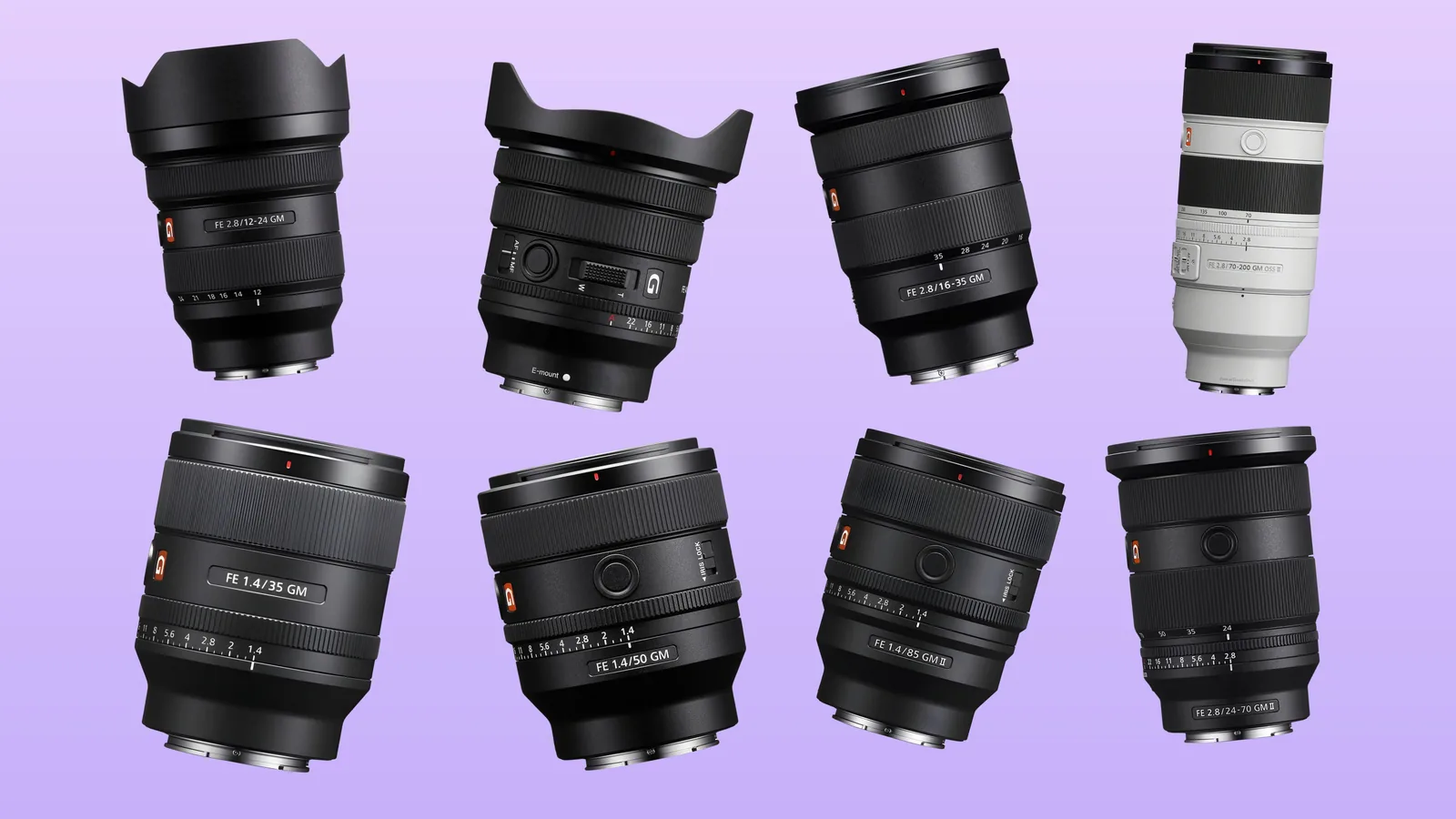
- A G Master (GM) lens is Sony's top-tier E-mount lens range, sitting above the standard G line, built for maximum sharpness, bokeh and autofocus performance.
- G Master and G lenses both use pro-grade optics, but G Master uses more advanced elements, coatings and motors, which is what you're paying the premium for.
- G Master lenses work brilliantly on Sony E-mount bodies like the FX3, FX5, FX6 and FX9, since the autofocus is designed specifically around Sony's own tracking algorithms.
- The Sony FR7 is the one common exception. For true remote pan/tilt/zoom, a Power Zoom (PZ) lens is preferred, not a G Master.
- If you're shooting on a PL mount cinema camera, a native PL lens is the practical choice, since G Master glass has no real route onto a true PL mount body.
You've probably seen "G Master" stamped on a lens and wondered what it actually means, or whether it's worth paying more for over a standard G lens.
It's a fair question.
The naming alone doesn't tell you much, and the answer changes depending on what camera you're shooting on and what the job needs.
We hire out a lot of Sony glass, and G Master comes up in nearly every conversation about lens choice.
Here's what the badge actually means, what it's good for, and where it isn't the right call.
What Is a Sony G Master Lens?
A G Master lens is the highest tier in Sony's E-mount lens range, sitting above the standard G line.
Sony introduced the G Master series in 2016 to sit above its existing G-series lenses, and the badge has since expanded to cover primes, zooms and macro lenses across the full-frame lineup, all engineered to squeeze the most detail and resolution out of Sony's sensors, at a premium price to match.
In practice, this means G Master lenses are Sony's answer to the question "what's the best glass we can put on this camera body."
If you're renting a Sony E-mount lens for a shoot where image quality is non-negotiable, chances are you'll end up looking at G Master first.
What's the Difference Between a G Lens and a G Master Lens?
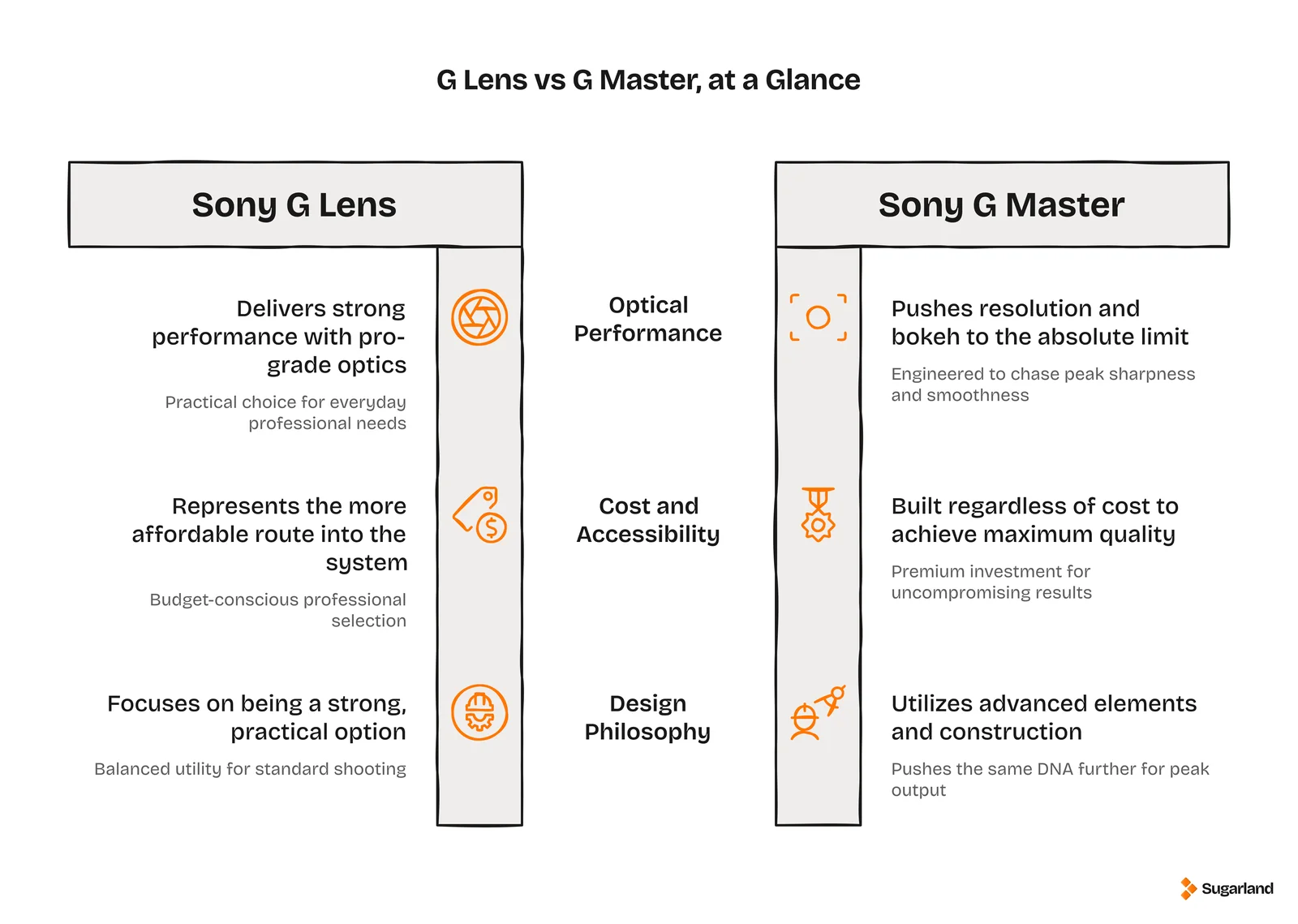
The core difference is optical design and build quality, with G Master using more advanced elements and construction to push resolution and bokeh further than the standard G line.
Sony still describes its G-series lenses as a strong option in their own right, and they're often the more practical choice when you don't need the absolute best G Master can offer.
At a glance:
- G lenses: pro-grade optics, strong performance, the more affordable route into Sony's system.
- G Master lenses: the same DNA pushed further, built to chase peak sharpness, bokeh and autofocus regardless of cost.
Both lines are built for enthusiasts and professionals, and both perform well.
If the shot calls for the sharpest possible image, the smoothest bokeh, or the fastest autofocus Sony can build, that's what G Master is for.
What Makes G Master Lenses Special?
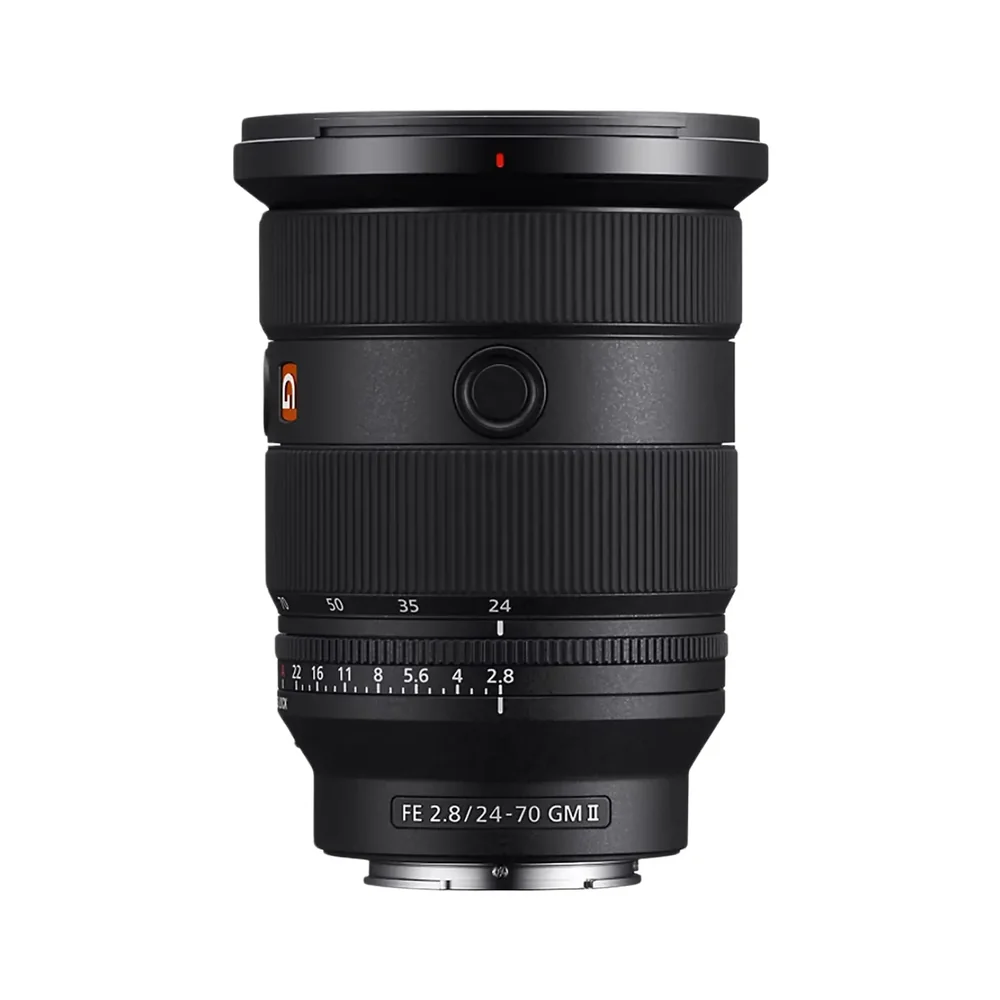
G Master lenses stand out because of the specific technology packed into them: extreme aspherical (XA) elements, Nano AR coatings, and fast linear autofocus motors, all working together to control aberrations and keep the image sharp from corner to corner.
A few of the details worth knowing:
- XA elements correct distortion and aberration far more precisely than standard aspherical elements, which matters most at wide apertures.
- Nano AR coating cuts down flare and ghosting, useful on any shoot with strong backlight or practical lights in frame.
- Linear or XD motors drive the autofocus system, giving fast, quiet, and precise focus pulls, which matters just as much for video as it does for stills.
None of this is marketing fluff. It's the actual engineering difference between a good lens and one built to be the best Sony can produce on that mount.
Are G Master Lenses Worth It for Video Work?
For video specifically, yes, mainly because of autofocus tracking, not just image sharpness.
GM lenses are built around the same tracking algorithms that make Sony bodies so good at holding focus on a moving subject, which is a bigger deal in video than in stills.
Reviewers consistently point to smoother continuous tracking and stronger eye detection as the standout benefits when shooting video on G Master glass, since the lens and camera are designed to talk to each other rather than being adapted or reverse-engineered to work together.
- Fast-turnaround social edit, where you're not chasing pin-sharp 4K detail: a standard G lens will do the job fine.
- High-end commercial or narrative shoot, where focus has to hold on a moving actor without hunting: G Master earns its keep.
Which Camera Should You Pair a G Master Lens With?
G Master lenses work best on native Sony E-mount bodies, and in our experience they're a perfect match for cameras like the FX3, FX5, FX6 and FX9.
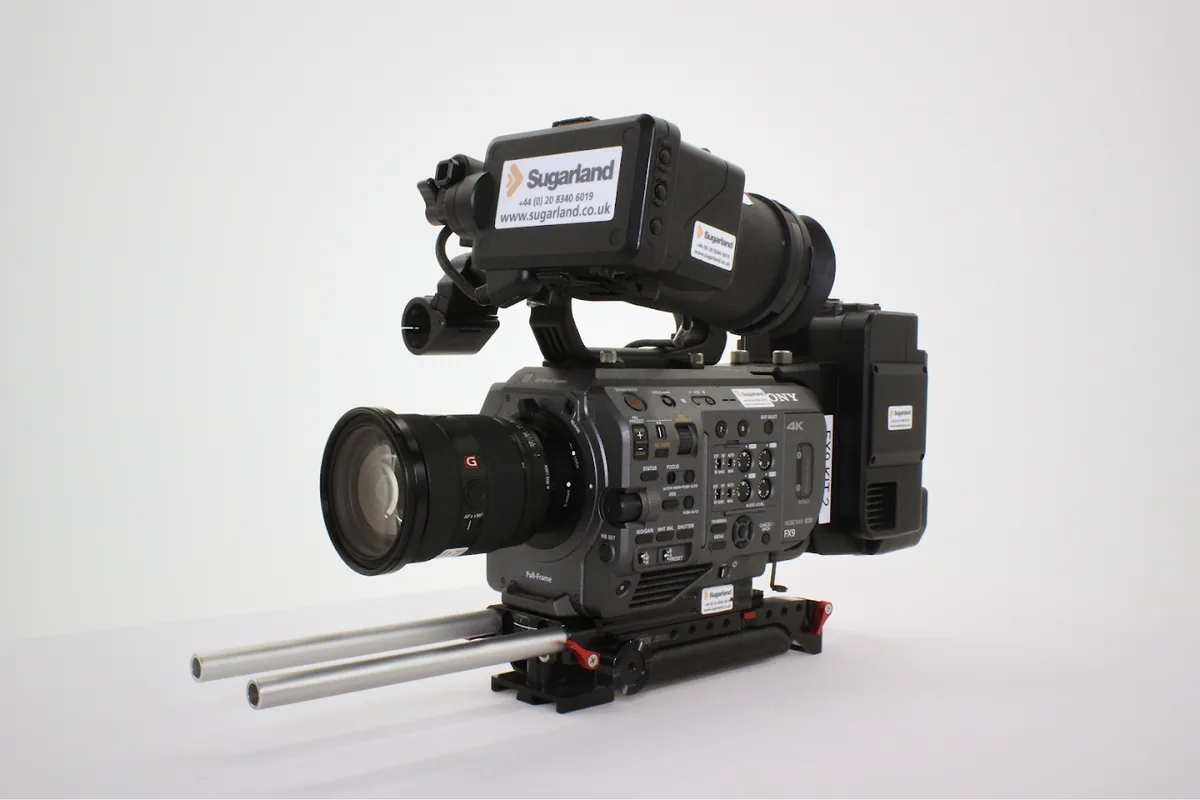
The autofocus, image stabilisation and metadata all communicate properly because the lens and body were designed for each other, so you get the full benefit of what you're paying for.
If you're hiring a Sony FX6 or similar body for a shoot, pairing it with G Master glass is close to a default recommendation for us.
The autofocus works exactly as intended, and you're not compromising on any of the features either the camera or the lens was built to offer.
The Exception: Why We Recommend Power Zoom Lenses for the Sony FR7
The one common exception is the Sony FR7. For that camera, we usually point clients toward a Power Zoom (PZ) lens instead of a G Master, because true remote pan/tilt/zoom control needs a PZ lens.
The FR7 is designed to be operated remotely, often mounted somewhere hard to reach, and controlled from a panel or joystick elsewhere on set.
To get proper remote zoom rather than just pan and tilt, it needs a Power Zoom lens, since a standard manual zoom lens loses that remote zoom control entirely.
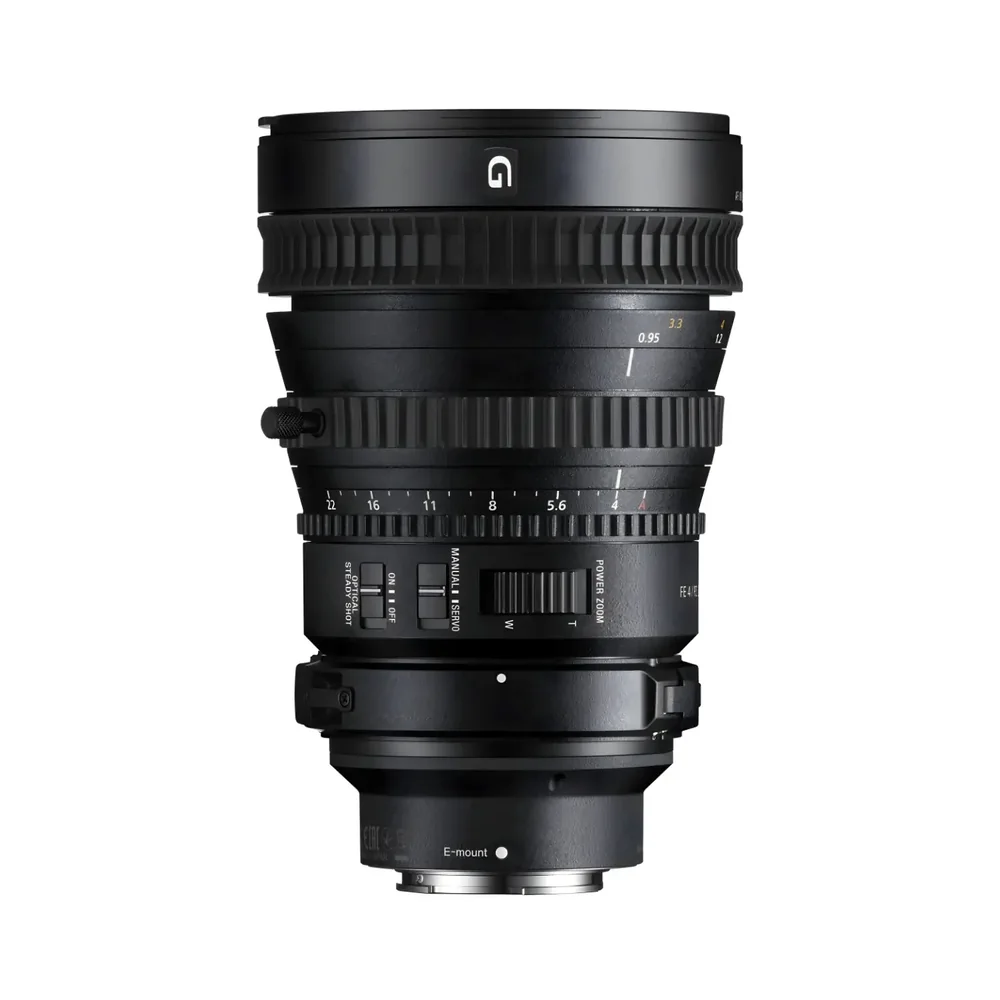
That's why we'll usually recommend something like the Sony PZ 16-35mm or the 28-135mm PZ lens for FR7 bookings.
- Need to adjust focal length remotely mid-shoot? Go with a PZ lens.
- Locked-off static shot, and you already know your framing? A standard lens on the FR7 is fine.
What If You're Shooting on a PL Mount Camera?
If your camera takes PL mount lenses rather than E-mount, native PL glass is the practical choice, not G Master.
G Master lenses are built around Sony's E-mount autofocus system, and that system doesn't carry across onto a PL mount body.
Adapters like the Vocas E-PL adapter work the other way round: they let you fit a PL cinema lens onto a Sony E-mount body. There isn't a practical route for putting a G Master lens onto a true PL mount camera.
For PL mount cameras, we'd usually point clients toward the Zeiss CP3 set, or one of the Canon CN10/CN7 cine-servo lenses, since these are native PL mount and built to work properly on cinema bodies without needing an adapter at all.
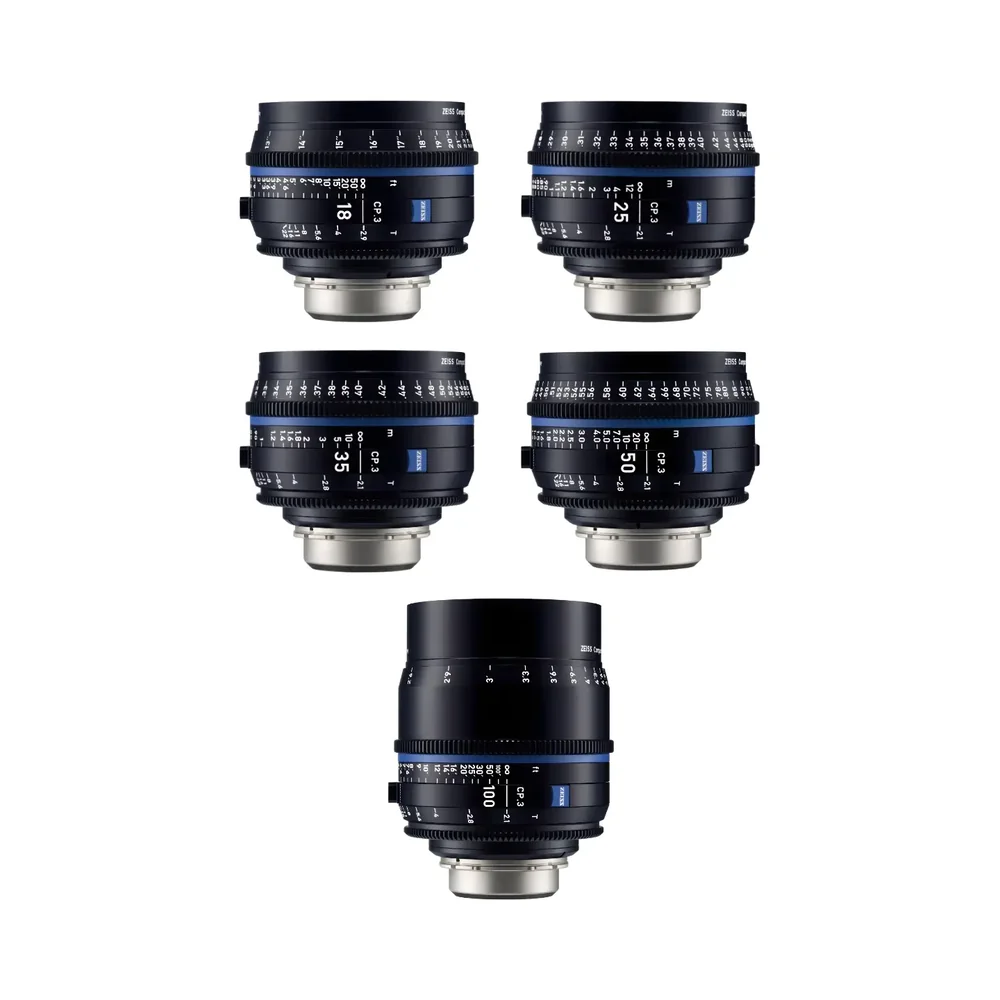
It comes down to matching the lens to the mount, not just the lens to the reputation.
The Bottom Line
Whether a G Master lens is worth it isn't really a G versus G Master question. It's a question of which camera you're shooting on and what the shot needs.
- Native Sony E-mount body (FX3, FX6, FX9): G Master is close to unbeatable.
- Sony FR7: go with a Power Zoom lens for remote zoom control.
- PL mount cinema camera: native PL glass, not an adapted G Master.
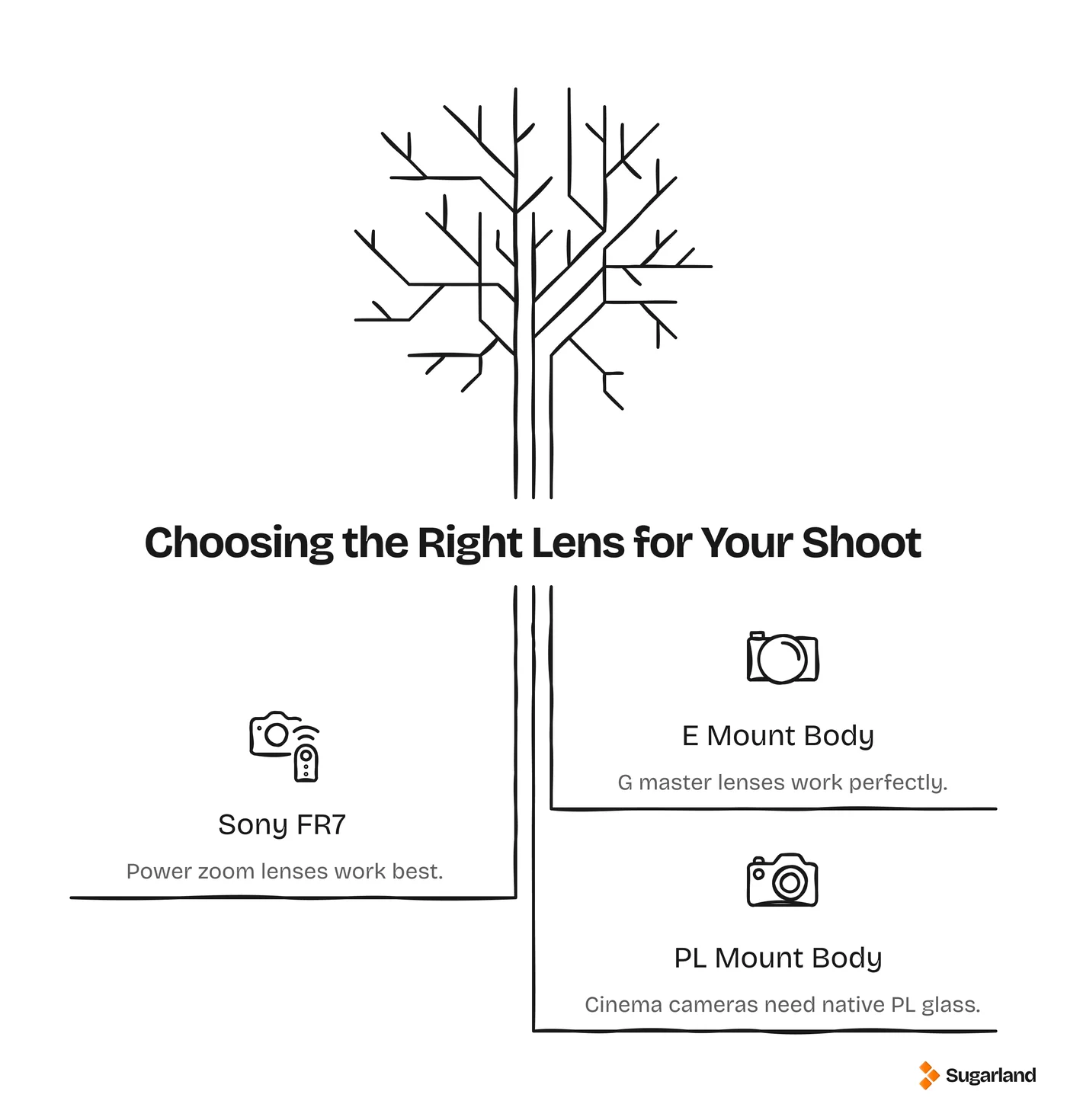
That's the advantage of hiring rather than buying: you don't need to commit to one lens system and make it work for every job.
You can match the kit to the shoot every time, and if you're not sure what's right for your setup, that's exactly the kind of question when you request a quote.
Let’s plan your next shoot
Get your equipment, studio and crew all in one place.