What Is a Drone Operator in Film & TV?
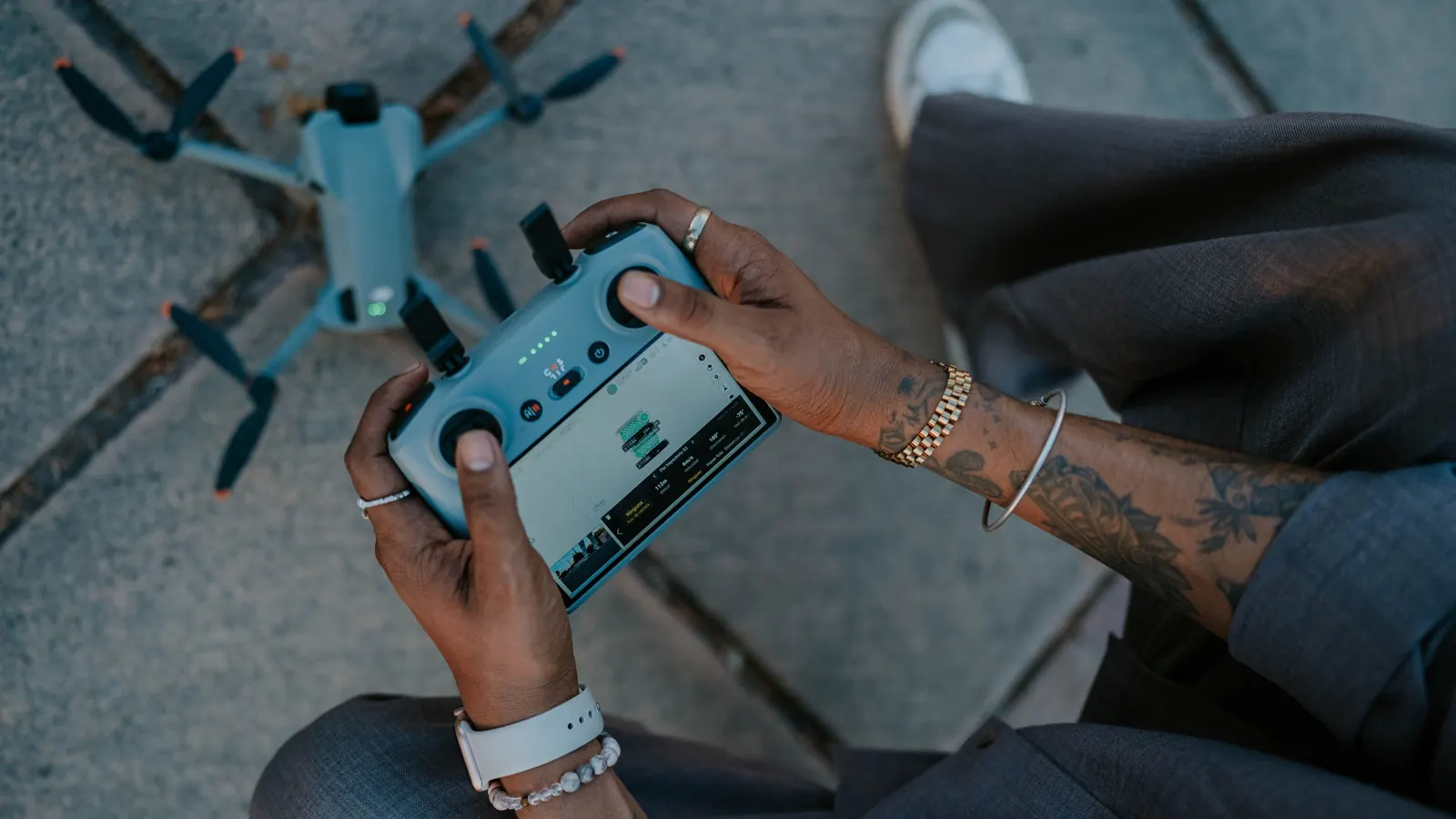
- A drone operator plans and flies the drone that captures aerial footage on a shoot, and keeps the flight legal and safe.
- There's no single "drone licence" in the UK. A professional operator needs a Flyer ID, an Operator ID, a GVC or RPC-L1 certificate, CAA Operational Authorisation and third-party insurance.
- If your location needs airspace permission, which much of London does, allow at least 3 weeks. Central London restricted areas and road closures can take longer.
- On bigger jobs, the aerial team often splits into a pilot and a separate camera operator.
- Sometimes a jib or crane gets the shot with none of the airspace paperwork.
A sweeping aerial shot can sell a music video, a fashion film or a brand campaign in seconds. Behind it is a drone operator, plus a stack of permissions most productions never see.
If you're planning a shoot with aerials, it helps to know what the role covers, what an operator needs to fly legally in the UK, and how much notice to give. Here's the practical version.
What Is a Drone Operator in Film and TV?
A drone operator is the crew member who plans, flies and manages the drone that captures aerial footage on a shoot.
They're responsible for getting the shot and for keeping every flight legal and safe.
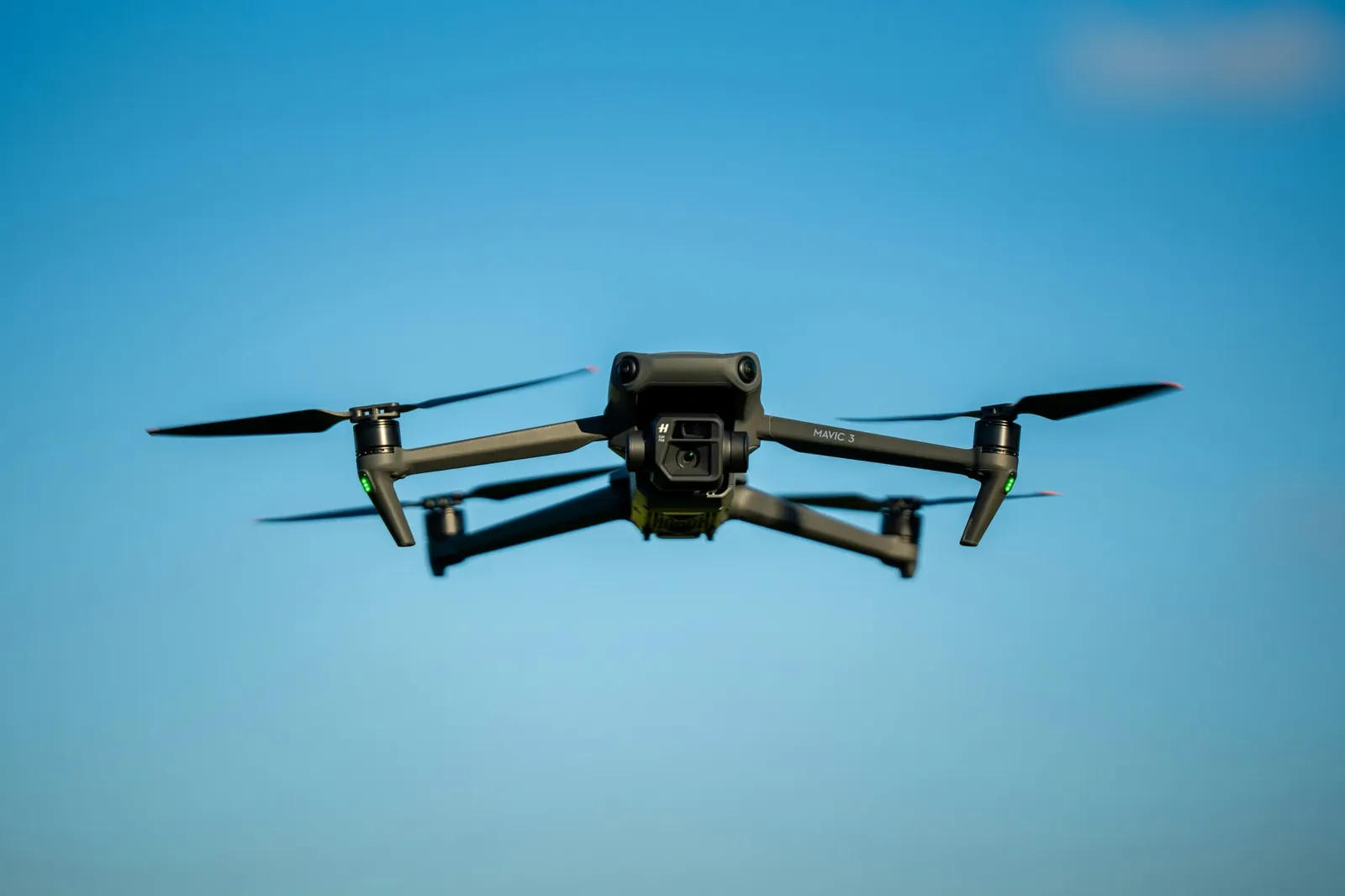
You'll also see the role called drone pilot, aerial operator or UAV pilot. On most productions they sit within the camera department, working to the director's brief.
What Does a Drone Operator Do on Set?
A drone operator plans the flight, secures the permissions, flies the shot and keeps everyone on set safe while the drone is up. The aerial shot you see on screen is the last step of a process that starts weeks earlier.
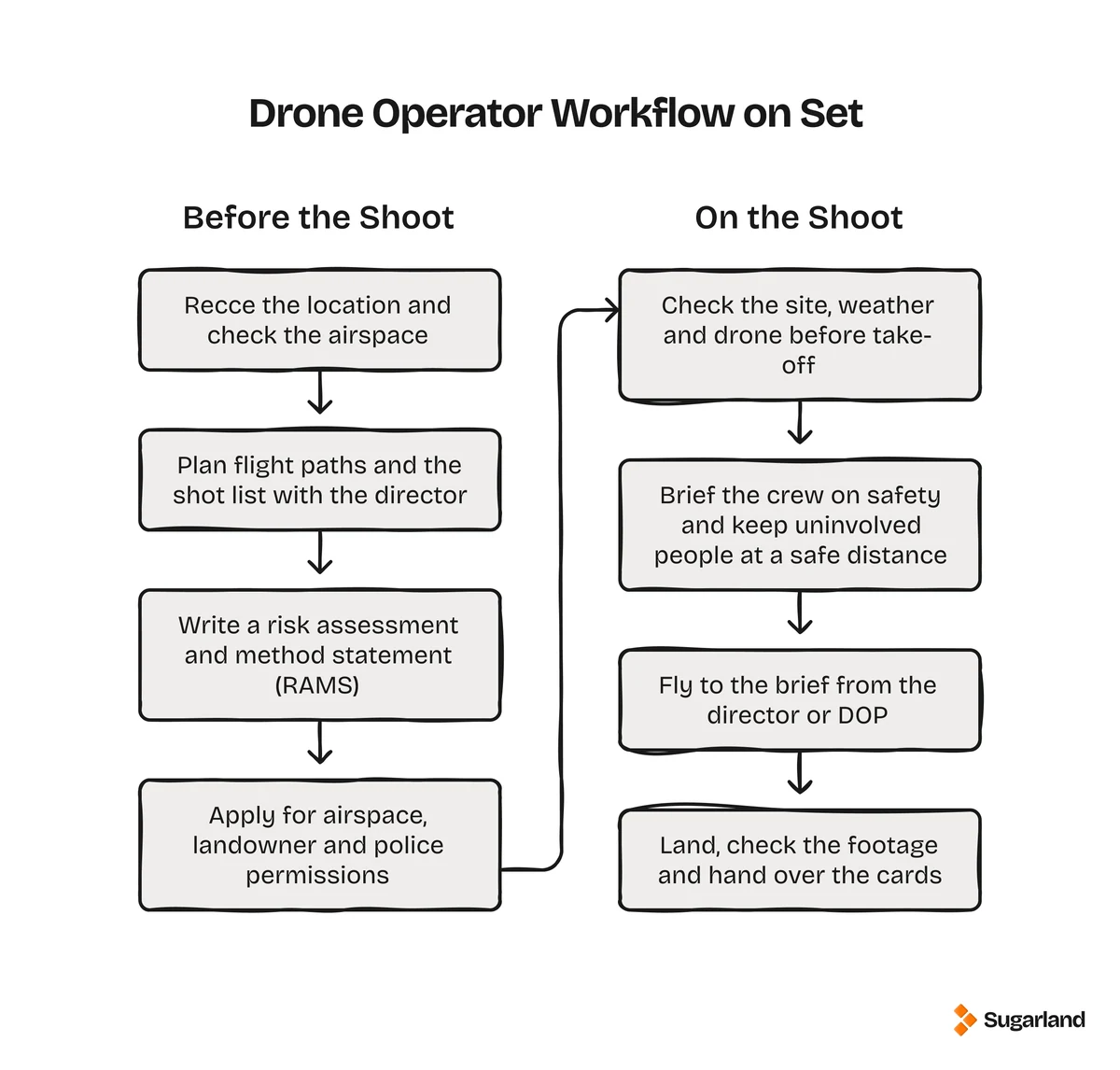
Before the shoot, they'll typically:
- Recce the location and check the airspace
- Plan flight paths and the shot list with the director
- Write a risk assessment and method statement (RAMS)
- Apply for airspace, landowner and police permissions
On the day, they'll:
- Check the site, weather and drone before take-off
- Brief the crew on safety and keep uninvolved people at a safe distance
- Fly to the brief from the director or DOP
- Land, check the footage and hand over the cards
The good ones also tell you early if a shot isn't safe or legal, rather than on the day.
Is a Drone Operator the Same as a Camera Operator?
No. A drone operator's core job is flying the aircraft, while a camera operator frames and moves the shot. On smaller shoots, a single drone operator handles both.
Single Operator vs Pilot and Camera Operator
On bigger productions, the aerial team often splits in 2. The pilot flies the drone and owns the safety of the flight, while a second operator controls the camera on the gimbal.
Some high-end aerial teams go further, with a pilot, a separate gimbal operator and a gimbal technician.
It's the same logic as a crane, where the person moving the rig isn't always the person framing the shot.
In my experience, there's no fixed rule. The setup depends on the job, the shots and the budget, so we match the team to what the production actually needs.
What Qualifications Does a Drone Operator Need in the UK?
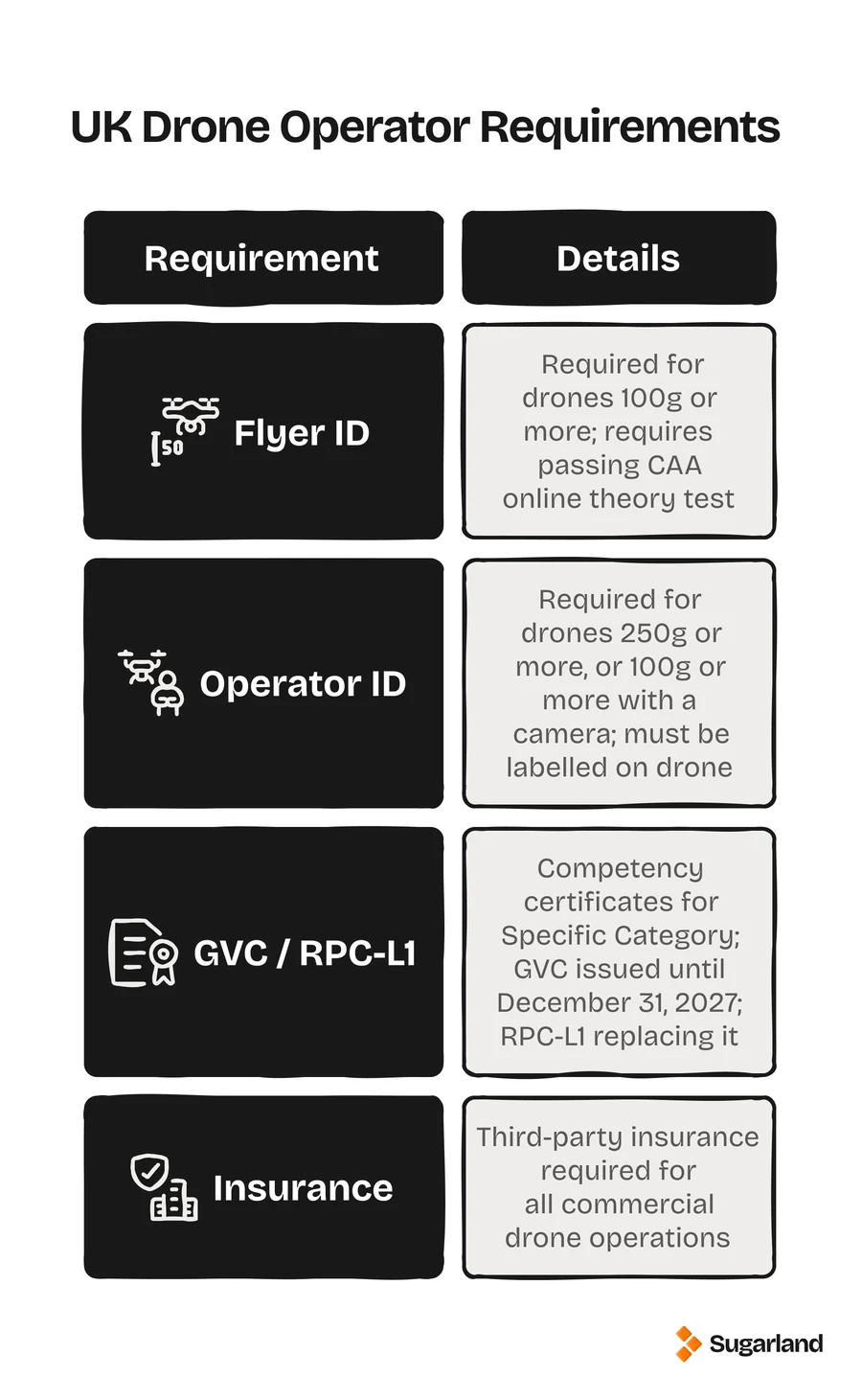
There's no single "drone licence" in the UK. A professional drone operator needs a combination of CAA registrations, a competency certificate, an authorisation to fly and insurance.
The rules changed on January 1, 2026, so check any operator is working to the current requirements.
Flyer ID and Operator ID
Anyone flying a drone of 100g or more now needs a Flyer ID, which means passing the CAA's online theory test.
An Operator ID is needed for drones of 250g or more, or 100g or more with a camera, and must be labelled on the drone.
In practice, any camera drone you'd use on a shoot needs both.
New models sold in the UK from 2026 carry UK class marks (UK0 to UK6), and drones with EU C-class marks are recognised until December 31, 2027.
GVC and RPC-L1
Many professional shoots, especially in towns and cities, fall outside the basic rules.
That means the operator needs a higher competency certificate and CAA Operational Authorisation for what's called the Specific Category.
The General Visual Line of Sight Certificate (GVC) has been the standard qualification for this.
The CAA has confirmed the GVC stops being issued on December 31, 2027, with the Level 1 Remote Pilot Certificate (RPC-L1) taking its place.
Both certificates are valid for 5 years. Existing GVCs stay valid until they expire, as long as the operator's authorisation accepts them.
Hiring tip: ask to see the operator's Flyer ID, Operator ID, GVC or RPC-L1, and Operational Authorisation before you book.
Insurance
Anyone flying a drone commercially must hold third-party insurance as a minimum.
That's the operator's legal responsibility, so confirm the cover is in place and suits your shoot before the day.
Filming With a Drone Operator in London
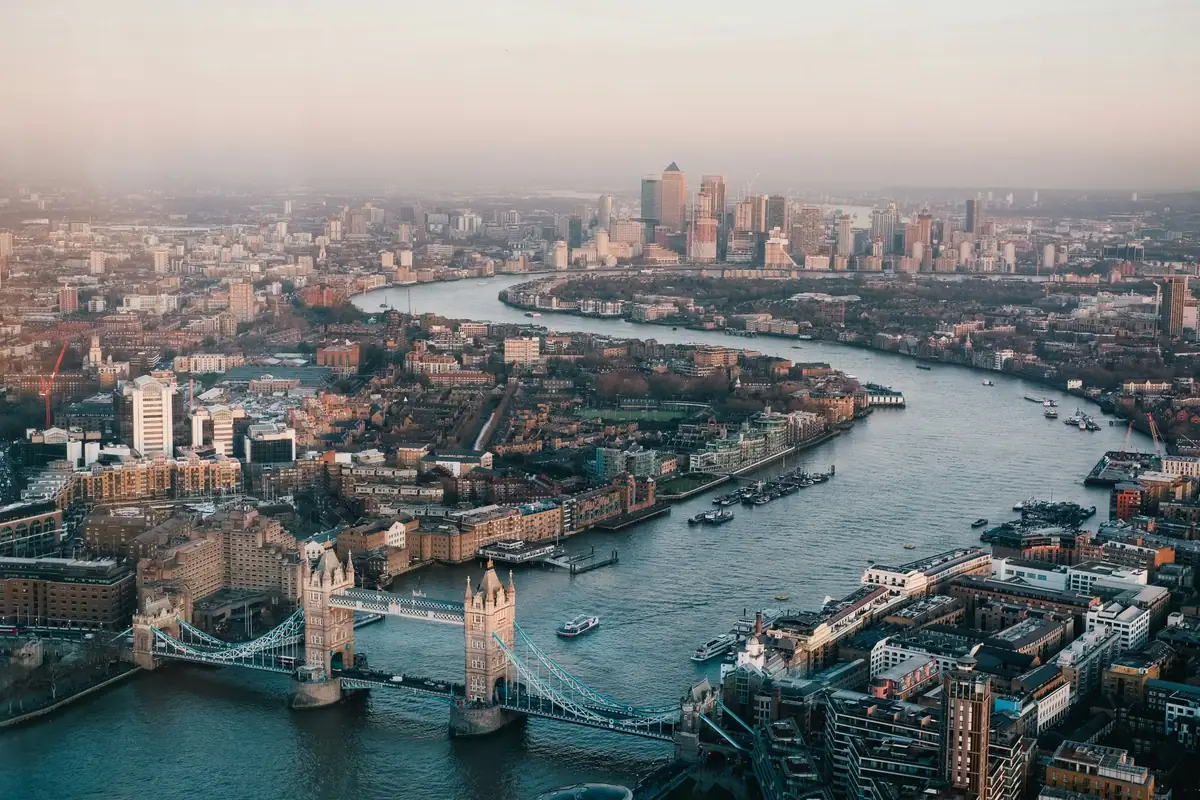
London is one of the hardest places in the UK to fly a drone.
Restricted airspace covers the City of London, much of Westminster and the Isle of Dogs, plus the zones around Heathrow and London City airports.
The basic drone rules don't get you far here either. Larger drones flying under them have to stay 150m from residential, commercial and recreational areas, which rules out most of the city.
Film London's permissions checklist sets out what a production needs before a drone goes up:
- Permission from the landowner for take-off and landing
- Control of the area you're flying over, which can mean road closures or traffic control
- CAA Operational Authorisation for Specific Category flights
- Enhanced Non-Standard Flight (ENSF) clearance from NATS for restricted airspace
- A Drones CAD from the Met Police Film Unit, so local police know about the flight
- Public liability cover of at least £5m
Parks add another layer. The central London Royal Parks all sit in restricted airspace, so they need extra approvals that vary by park, plus licence fees.
It's difficult, but not impossible. We've secured permission for central London shoots in restricted areas, but only for a specific window at a specific time.
Plan your schedule around the permission window, not the other way round.
How Much Notice Does a Drone Shoot Need?
Give a drone shoot at least 3 weeks' notice if it needs airspace permission, and more in central London.
Drone jobs need more lead time than other crew bookings because the permissions can't be rushed.
NATS asks for at least 21 days' notice on Non-Standard Flight applications, and says applications in London's restricted areas may take longer.
Anything submitted less than 7 days before the flight may not be processed at all.
Other permissions run on their own timelines. Film London notes that road closures on some London streets can take 12 weeks to arrange.
Most crew bookings get easier with notice. Drone jobs depend on it, so get in touch as soon as aerials are on the table.
Do You Always Need a Drone?
Sometimes the honest answer is no. A drone is the right tool for big, sweeping moves, but plenty of "aerial" shots can be done from the ground.
A jib or crane can give you a rising reveal or a high angle without any airspace paperwork. For smooth moves at ground level, a camera dolly or slider might be the better fit.
When a client asks for aerials, we'll sometimes suggest a jib or crane instead if it gets the same shot. Tell us what you're after, and we'll help you find the simplest way to get it.
How Do You Become a Drone Operator?
Most drone operators start with CAA-approved training, build up logged flying hours, then apply to the CAA for Operational Authorisation. On film and TV work, camera skills matter too, because the operator is framing shots as well as flying.
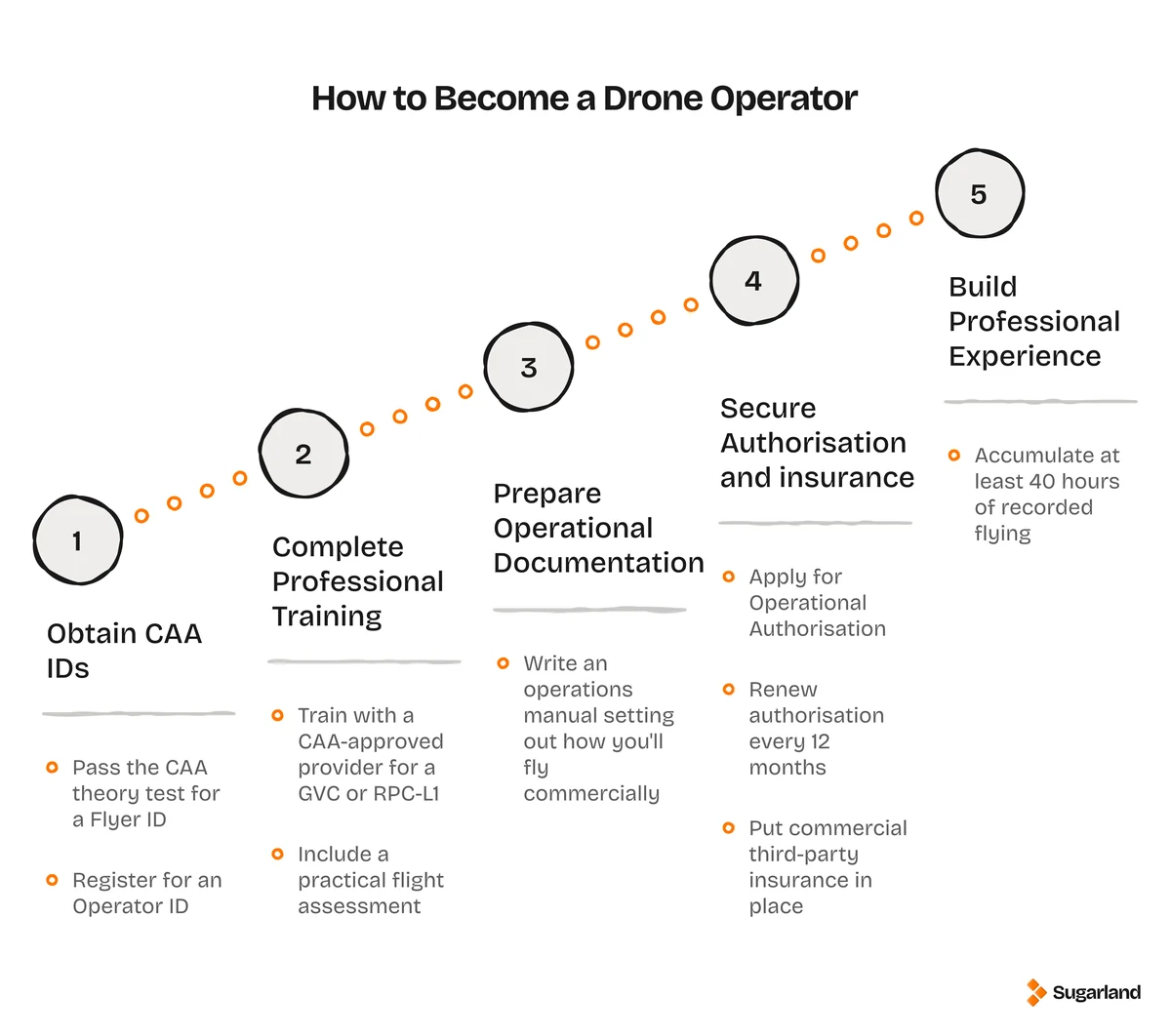
The usual route looks like this:
- Pass the CAA theory test for a Flyer ID, and register for an Operator ID
- Train with a CAA-approved provider for a GVC or RPC-L1, including a practical flight assessment
- Write an operations manual setting out how you'll fly commercially
- Apply for Operational Authorisation, then renew it every 12 months
- Put commercial third-party insurance in place
Experience counts as much as paperwork. Most employers expect at least 40 hours of recorded flying before they'll hire a drone pilot.
Hiring a Drone Operator for Your Shoot
Need aerials alongside the rest of your kit and crew? At Sugarland, we supply drone operators as part of our crew hire, next to the cameras, lighting, grip and crew already on your shoot.
Like the rest of our crew, our drone operators are freelancers, so availability depends on who's booked.
With the permission lead times above, the earlier you get in touch, the better.
A few things to know:
- Day rates vary by the operator's experience and what the shoot involves, so every job is quoted individually
- Travel and meals are paid by the client, not included in the crew rate
- Your quote spells out exactly what's included for your shoot, and any extra kit from our catalogue is quoted separately
- We're based in London and work UK-wide and internationally, with anything outside London quoted case by case
Tell us the shot, the location and the date, then request a quote. We'll come back with the right operator and setup for the job.
Let’s plan your next shoot
Get your equipment, studio and crew all in one place.